Certified Austenitic Steel
Precision-milled AISI 304 (18/8) steel sheets exhibiting unmatched chemical passivity against organic acids, extreme culinary brine, and thermal stress during rigorous commercial dishwashing cycles.
Within international hospitality, high-turnover culinary franchises, and retail cookware distribution, selecting Stainless Steel Kitchen Tools is no longer merely an aesthetic catalogue decision. It has transformed into an intensive calculation of metallurgical chemistry, ergonomic fatigue thresholds, and international consumer safety mandates. As global regulators phase out polyfluoroalkyl substances (PFAS), microplastic-shedding synthetic nylons, and substandard silicone blends, industrial procurement officers are systematically returning to cold-forged and precision-stamped austenitic and ferritic stainless steel.
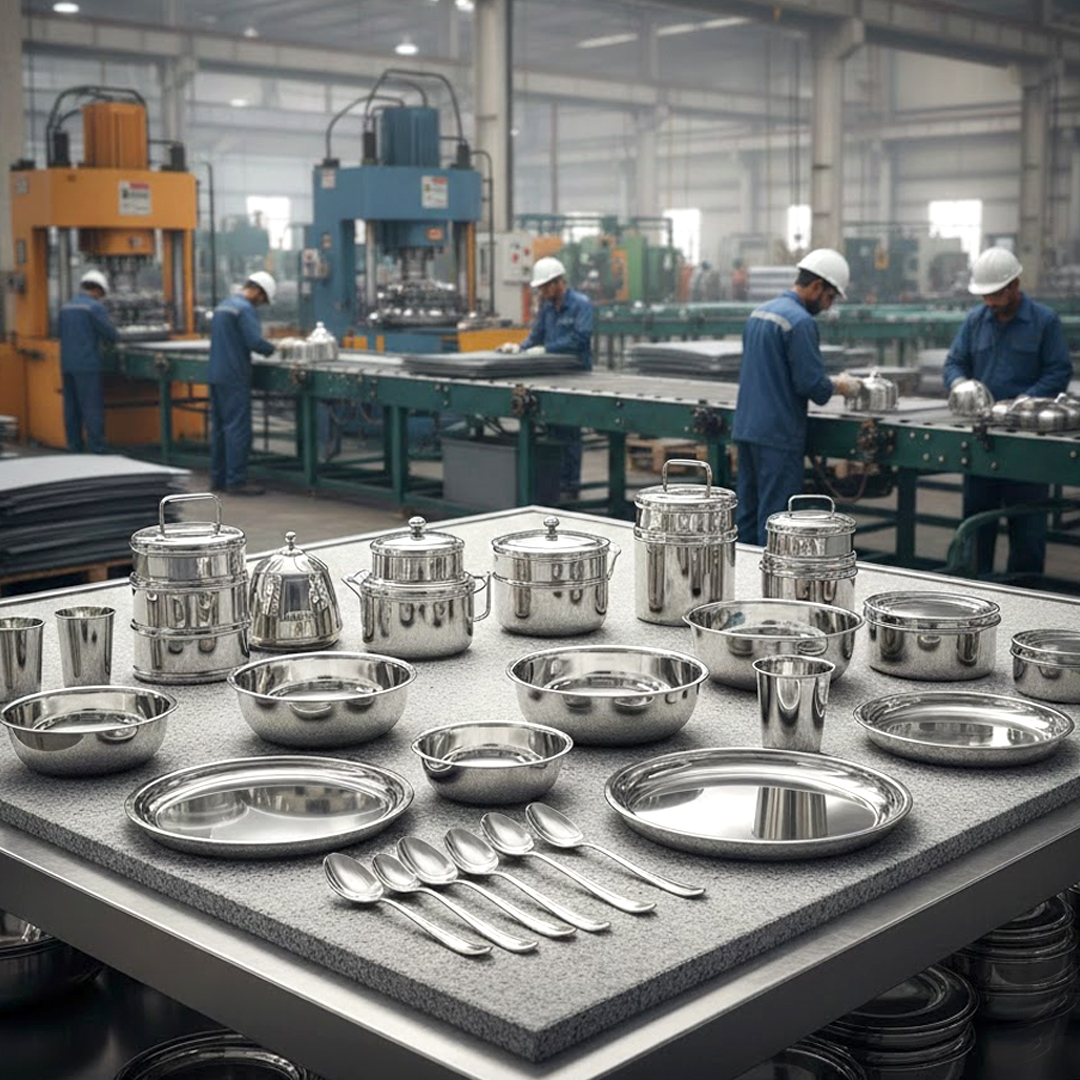
Founded in 1991 in Delhi, India, Saurabh Steels (India)—operating globally under the consumer and hospitality brand Sorabh Kitchen World—has spearheaded the design and mass fabrication of high-durability kitchen tools for over 31 years. Spanning more than 700 finished kitchen SKUs across five material families, our production infrastructure bridges heavy mechanical tensile stability with artisanal, hand-buffed mirror polishes. By operating fully owned deep-drawing, hydraulic pressing, and robotic finishing cells, Sorabh Kitchen World empowers global buyers across North America, Europe, the Middle East, and Asia to mitigate supply volatility while ensuring uncompromised food-grade compliance.

Precision-milled AISI 304 (18/8) steel sheets exhibiting unmatched chemical passivity against organic acids, extreme culinary brine, and thermal stress during rigorous commercial dishwashing cycles.

Single-piece unibody deep-drawn geometries eliminate mechanical joints, crevices, and weak spot rivets where grease or microbial bacterial colonies gather, satisfying HACCP hygiene audits.

Engineered handle profiles utilizing hollow core balance geometries and ventilated thermal-break junctions that prevent radiant conduction from searing pans to the chef's grip.
In commercial kitchens, culinary utensils endure thousands of dynamic flex actions each shift: lifting dense cuts of meat, shearing through deep-fryer crusts, and undergoing abrasive thermal shocks. When an economy kitchen tool bends or snaps along its shank weld, it disrupts service and introduces immediate food hazard risks. Sorabh Kitchen World engineers each tool blank with reinforced gussets, optimized neck radii, and work-hardened stainless alloys that maintain mechanical memory and spring tension under aggressive loads.
Targeted product lines designed for department stores, multi-unit restaurant operations, wholesale distributors, and e-commerce private-label portfolios.
Heavy-DutyPrecision-stamped from a single 2.0 mm heavy-gauge stainless blank. The beveled leading edge slides effortlessly beneath delicate proteins without gouging cookware, while custom perforation drainage arrays maximize fluid runoff speed.
HoReCa CoreEngineered for commercial deep-frying and pasta boiling kettles. Laser-perforated stainless bowl geometries provide lightning-fast liquid separation while resisting thermal deformation at continuous 220°C oil immersion.
Portion ControlCalibrated volumetric capacities (from 30ml to 500ml) stamped directly into the handle shaft for portion management. Rolled dripless rim contours ensure mess-free sauce distribution in commercial banquet service lines.
Anti-FatigueHigh-tensile spring steel wire loops locked inside a weighted cylindrical handle with food-grade waterproof resin sealant. Zero water infiltration during commercial dishwashing cycles preserves interior balance and hygiene.
Precision GripEngineered using 1.0mm cold-worked stainless steel arms with scalloped tooth grip geometry. Built-in sliding lock ring mechanism holds high-intensity line cooking performance without springing loose or jamming under heavy sauce exposure.
Deliver custom branded tool collections with localized packaging, laser-etched barcodes, customized hang tags, and targeted metallurgical thickness to conquer your regional market.

The international procurement landscape for culinary hardware is undergoing a structural transformation. Global retail giants and hospitality distributors are aggressively revising their supplier portfolios to comply with Corporate Sustainability Due Diligence Directives (CSDDD). Plastic spatulas and silicone-handled kitchen tools, long favored for nominal unit costs, now generate compliance liabilities due to microscopic chemical leaching at boiling oil temperatures and severe non-biodegradability.
Consequently, procurement managers are pivoting toward 100% infinitely recyclable stainless steel tools. Furthermore, with geopolitical risks prompting buyers to pursue "China+1" diversification strategies, India's seasoned metallurgical manufacturing belt—exemplified by Saurabh Steels in Delhi—has emerged as a premier procurement hub. Supported by indigenous raw ore refining, automated press lines, and certified quality controls, Indian supply chains deliver long-term tariff advantages and reduced geopolitical exposure.

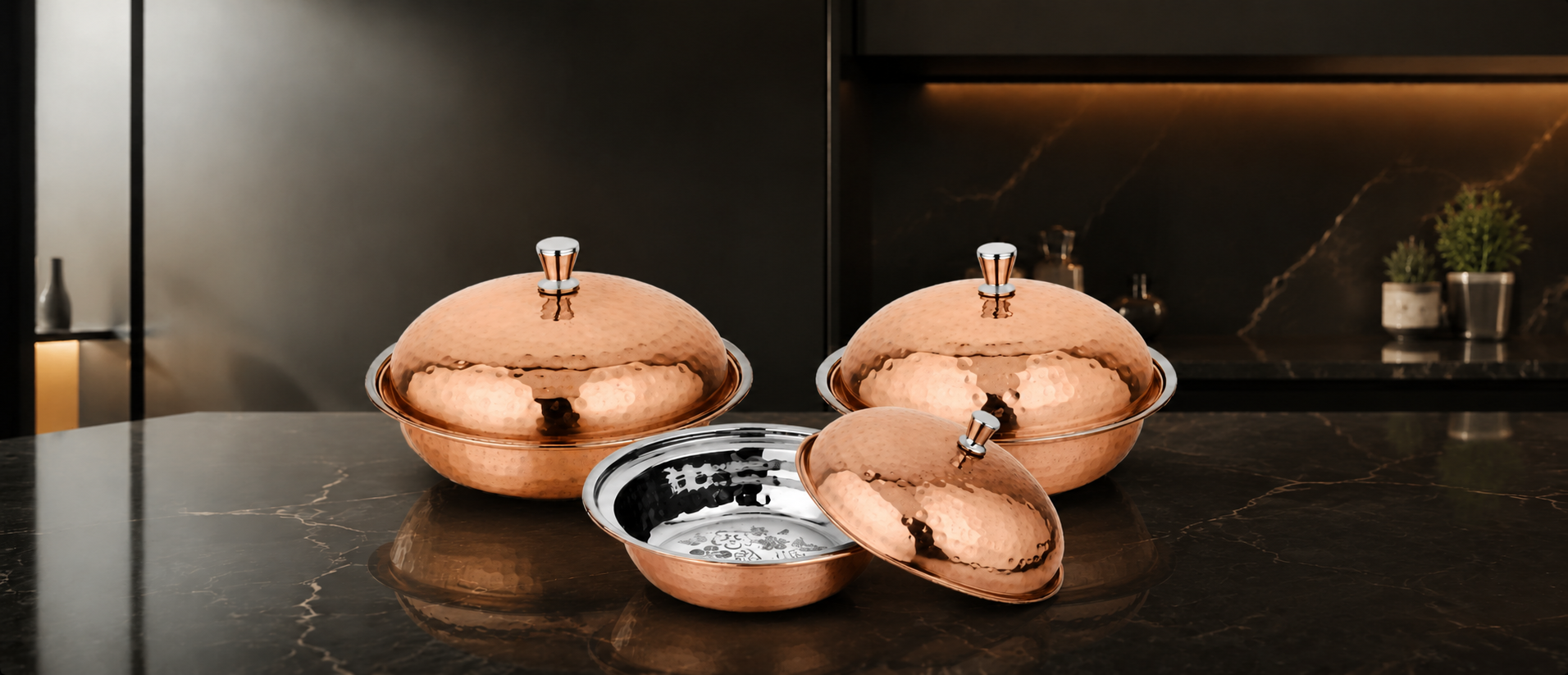
Historically, commercial kitchen utensils were manufactured as rudimentary flat sheet pressings with sharp punched edges and spot-welded brackets that succumbed to rust after weeks in commercial warewashers. Contemporary culinary engineering integrates compound ergonomic radii, laser-trimmed edges, and chemical passivating treatments.
Modern kitchen tools incorporate high-definition Physical Vapor Deposition (PVD) titanium coatings—offering elegant matte black, champagne gold, and rose finishes that withstand commercial abrasion while remaining chemically inert. Simultaneously, tool geometry is adapting directly to induction cooking vessels and heavy multi-clad triply surfaces: contoured spatulas replicate wok radii, whereas slotted fish turners utilize surgical-grade flexibility to maneuver under delicate fillets without damaging premium cooking surfaces.
Critical metallurgical, thermal, and corrosion benchmarks used by testing laboratories and procurement directors to evaluate stainless steel tool performance.
| Metallurgical Grade | Chemical Composition | Corrosion Resistance | Tensile & Yield Strength | Sanitization Suitability | Optimal Commercial Use Case |
|---|---|---|---|---|---|
| AISI 304 (18/8 - 18/10) | 18-20% Cr, 8-10.5% Ni, ≤0.08% C | Exceptional; immune to boiling citrus, tomato acids, and high-saline liquids | High ductility; absorbs repeated high-torque flexing without cracking | Withstands aggressive industrial autoclave and alkaline dishwasher cycles | Premium hospitality front-of-house, executive cookware sets, heavy basting spoons |
| AISI 430 (18/0 Ferritic) | 16-18% Cr, ≤0.75% Ni, ≤0.12% C | Moderate; prone to micro-pitting in prolonged exposure to acidic brine | Higher hardness, slightly lower work elasticity under torsional loads | Requires neutral pH detergents; magnetic properties facilitate rack storage | High-volume retail promo lines, magnetic display tools, dry food scoops, pastry scrapers |
| AISI 201 (Modified Austenitic) | 16-18% Cr, 3.5-5.5% Ni, 5.5-7.5% Mn | Standard; vulnerable to pitting under acidic, high-chloride marinades | High tensile strength; stiffer feel due to work-hardened manganese content | Good standard performance; prompt drying recommended to prevent staining | Budget-conscious mass retail assortments, light-duty dry catering, economy bar tools |
| AISI 420 (Martensitic Steel) | 12-14% Cr, ≤0.5% Ni, >0.15% C | Specialized; heat treated for extreme edge retention and blade sharpness | Exceptional hardness (50-55 HRC); rigid, minimal bending flex | Hand wash recommended for edge protection; dry storage required | Offset bench knives, cheese planes, serrated edge turner blades, pizza cutters |
Quality Assurance Protocol: Sorabh Kitchen World validates alloy chemistry using in-line Optical Emission Spectrometry (OES) and salt-spray chamber tests conforming to ASTM B117 international corrosion standards.
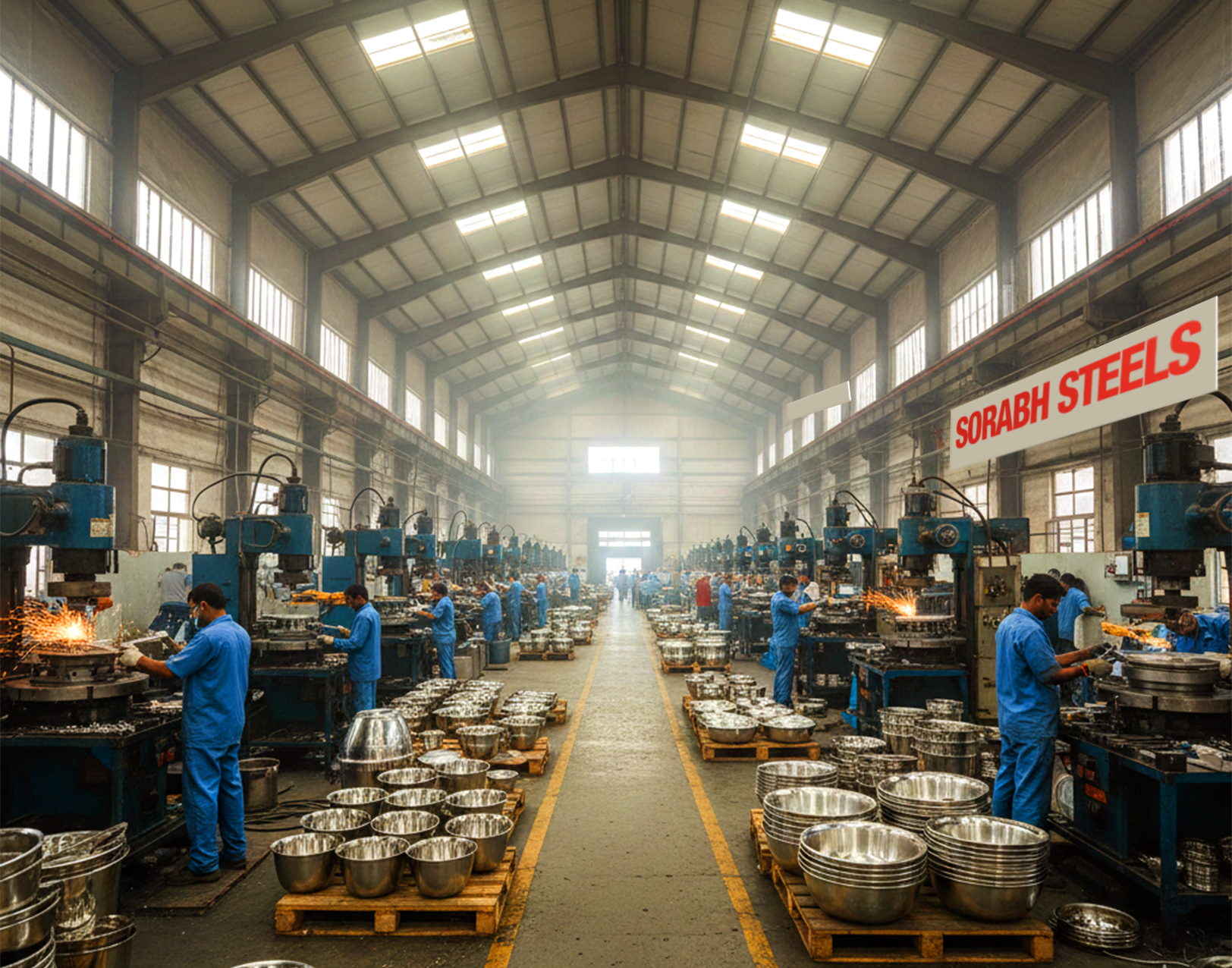
Inspection-ready surface finishes, hydraulic deep-drawing consistency, and pristine edge hand-finishing.


Behind every shipment is the verifiable industrial footprint of Saurabh Steels (India).


True manufacturing authority does not reside in marketing decks; it is built on the factory floor through daily mastery of metallurgical metallurgy, hydraulic tonnage adjustments, and tooling calibration. Since 1991, our executive leadership has overseen every phase of expansion from our Delhi industrial epicenter.
Whether calculating blanking pressures for 18/10 stainless grades or fine-tuning robotic polishing lines to achieve mirror finishes without micro-abrasion, Saurabh Steels provides the engineering transparency global procurement teams demand.
A transparent, milestone-driven OEM/ODM production methodology crafted for global commercial sourcing.
Definition of steel grade (304 vs 430), gauge thickness, neck reinforcement gussets, and CAD tooling specifications.
Die-cutting, hydraulic test stampings, and physical pre-production master samples shipped via express courier for sign-off.
Automated press line stamping, ultrasonic degreasing, electro-polishing, and batch spectrographic alloy verification.
Custom barcode labeling, drop-tested master cartons, and palletized container loading bound for international ports.
Authoritative metallurgical perspectives from our engineering laboratories to guide corporate purchasing.

A practical audit blueprint for corporate buyers: how X-ray Fluorescence reveals scrap-metal adulteration in imported utensils, and why cyclic bend-stress tests prevent line failures in commercial kitchens.

Why commercial kitchens are moving toward unibody solid tools to prevent internal water infiltration and sudden bacteria proliferation.

Nesting engineering strategies, bulk master-carton optimization, and minimizing dead-freight costs across ocean transport routes.
Critical answers concerning alloy formulation, chemical safety validation, private-label MOQ thresholds, and logistical execution.
For high-intensity food preparation, acidic marinades, and repetitive warewashing, AISI 304 (18/8 or 18/10 austenitic steel) remains the undisputed international benchmark. Its high nickel balance (8% to 10%) forms an impervious, self-healing passive chromium-oxide layer that resists aggressive pitting from salt and organic acids. AISI 430 (ferritic steel) represents an economical, nickel-free alternative suitable for dry-ingredient handling, pastry bench tools, and magnetic wall-strip display lines, but is vulnerable to micro-corrosion if exposed to standing brine.
Mounting regulatory bans on PFAS (per- and polyfluoroalkyl substances) and heightened consumer awareness surrounding microplastic shed have made synthetic kitchen utensils a commercial liability. In contrast, heavy-gauge stainless steel kitchen tools provide non-porous, chemically inert food contact surfaces that withstand temperatures exceeding 500°C without melting, off-gassing, or warping. Furthermore, high-tensile steel is 100% recyclable, directly advancing ESG mandates.
Every batch of cold-rolled stainless steel coil entering our Delhi facility undergoes mandatory X-Ray Fluorescence (XRF) and Optical Emission Spectrometry (OES) analysis to confirm certified elemental limits. Our finished tools comply rigorously with FDA 21 CFR 175.300, European Framework Regulation (EC) 1935/2004, and German LFGB food contact requirements, certified by accredited third-party laboratories.
Monobloc tools are stamped from a continuous sheet of solid steel without welding, eliminating internal cavities and crevices that harbor food grease or bacterial colonies. Two-piece tools feature hollow handles joined by laser or spot welding to provide lightweight handling and thermal dissipation; however, if welds are defective, dishwasher water can enter the cavity, leading to internal corrosion and sudden microbial expulsion.
Standard OEM private-label production starts at 1,200 to 3,000 units per tool variant, based on custom stamping tooling, laser-etched branding, and packaging configurations. Complete multi-piece sets or consolidated catalog orders across our 700+ SKU inventory can accommodate mixed-container loadings. Standard factory lead times average 30 to 45 days ex-factory Delhi, with full customs documentation for seamless international transit.
Yes. Our in-house tool and die facility develops custom progressive blanking, piercing, and deep-drawing dies based on client CAD/STEP models. We support various handle finishes, including matte satin brushing, optical mirror buffing, anti-slip knurled detailing, and food-grade PVD titanium coatings.
Connect directly with our engineering and export team in Delhi to request CAD prototyping, sample kits, and wholesale container pricing.