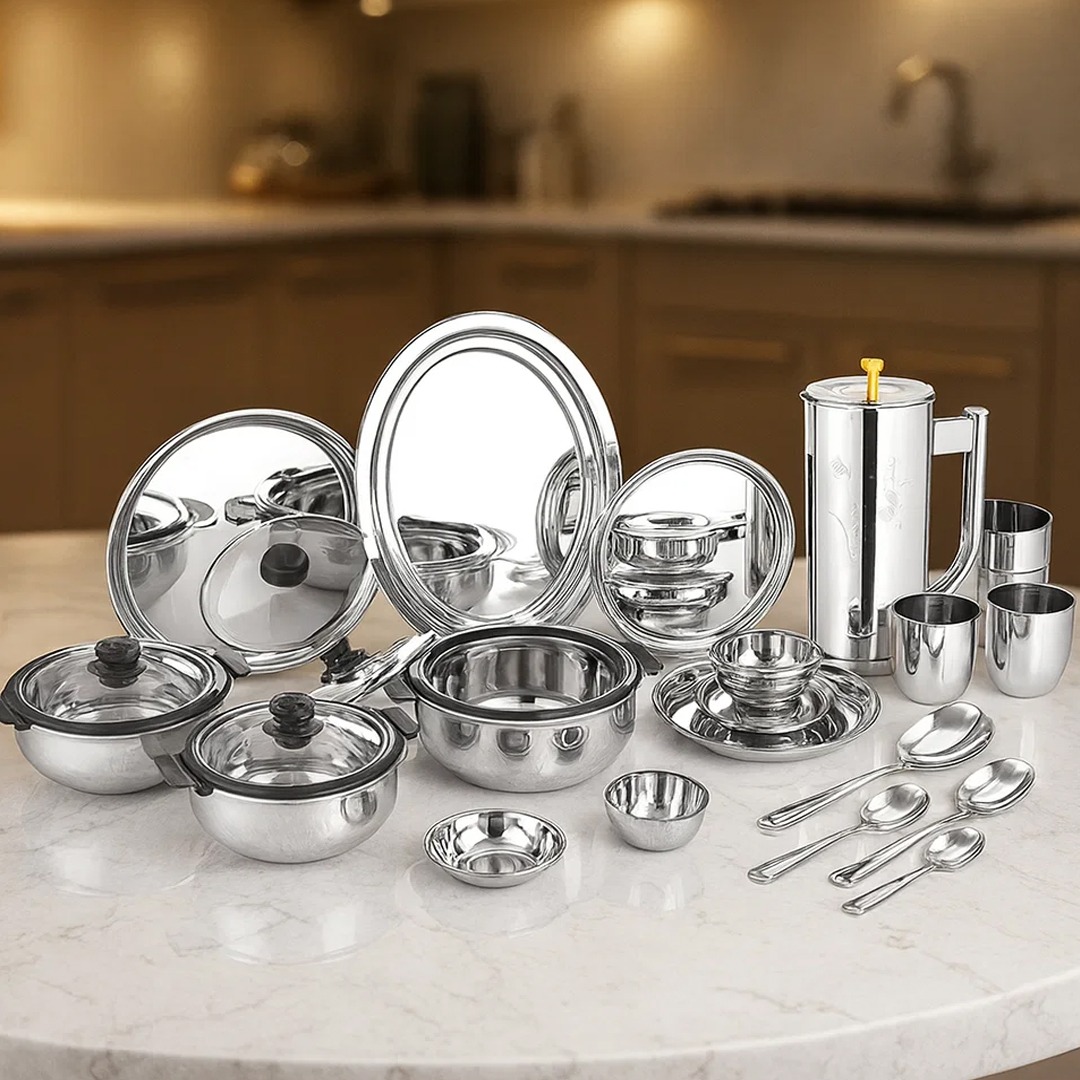
Metallurgical Stability (AISI 304/316)
Certified 18/8 and 18/10 austenitic alloys with high chromium-nickel ratios provide unmatched passive barrier resistance against acidic sauces, high-saline marinades, and thermal shock.
In modern high-traffic foodservice operations—ranging from luxury hotel banquets and Michelin-starred restaurants to corporate dining facilities—commercial hospitality serveware serves as both an aesthetic centerpiece and a critical capital asset. Hospitality procurement leaders, culinary directors, and project outfitters face unprecedented pressures: rising breakage rates from aggressive conveyor dishwashing machines, fluctuating metallurgical integrity from secondary steel mills, shifting global sustainability mandates banning single-use chafer fuels, and diner expectations demanding Instagrammable tabletop presentations.
Established in 1991 in Delhi, India, Saurabh Steels (India) operates its specialized trade division, Sorabh Kitchen World, bringing over 31 years of metallurgical mastery to solve these precise operational pain points. By combining heavy-gauge deep-drawing, precision-automated hydro-forming, non-reactive electropolishing, and multi-ply thermal cladding, we engineer enterprise-grade serveware that lowers five-year Total Cost of Ownership (TCO) by up to 40% compared to conventional decorative holloware.
Get a Quote
Certified 18/8 and 18/10 austenitic alloys with high chromium-nickel ratios provide unmatched passive barrier resistance against acidic sauces, high-saline marinades, and thermal shock.

Reinforced rolled edges, robotic seamless seam-welding, and hermetically sealed holloware cavities eliminate crevices where caustic wash chemicals, limescale, and food debris lodge.

Engineered for high-volume service: stackable footprint geometries reduce back-of-house storage volume by 35%, while ergonomic stay-cool handles safeguard front-of-house service staff.
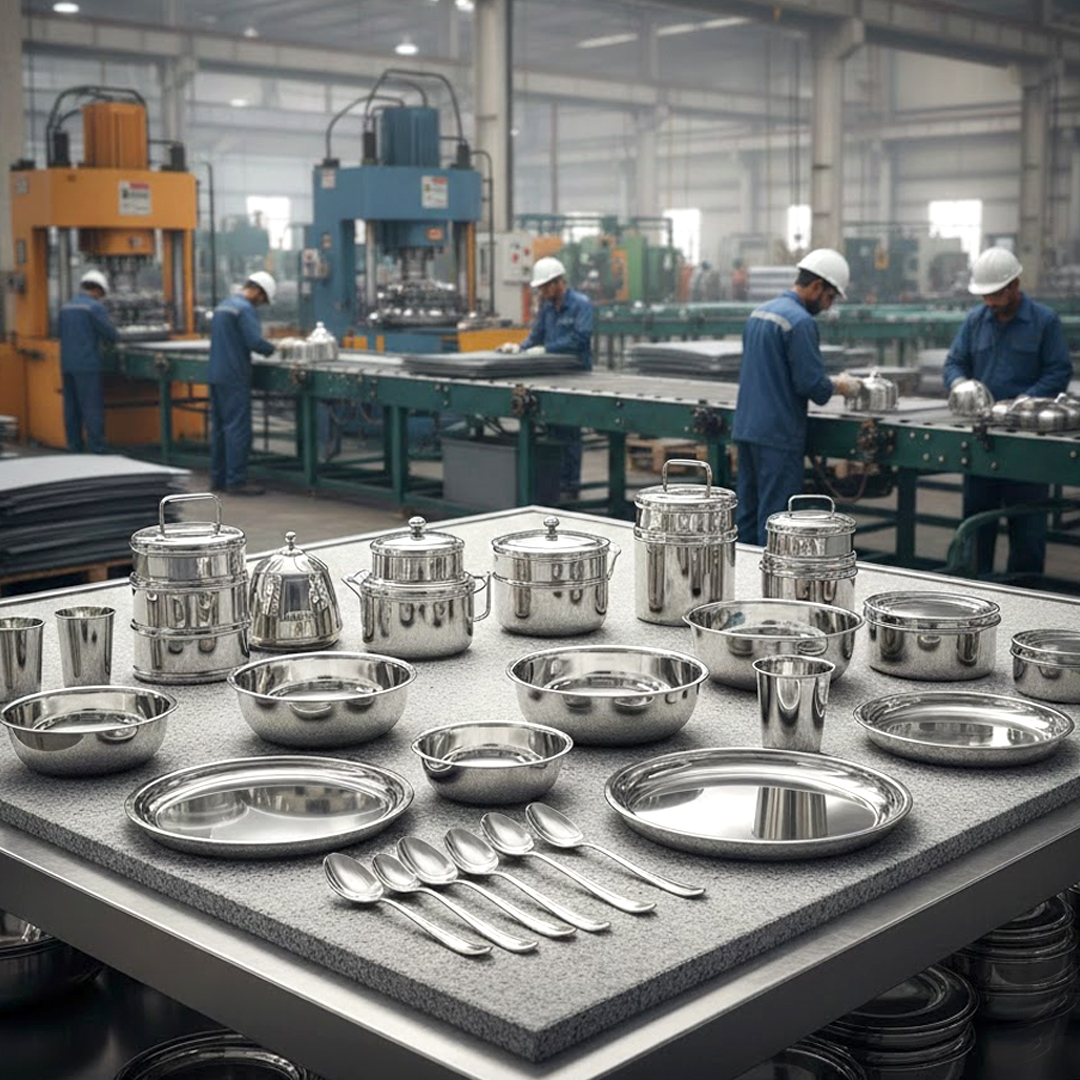
Procuring hospitality serveware directly from an integrated Indian manufacturing house gives international importers, hotel groups, and distributors a resilient supply chain free from trading markups. Our Delhi manufacturing facility houses multi-station hydraulic deep-drawing presses, CNC spinning lines, automated mirror-buffing machines, and laser engraving units, delivering world-class craftsmanship at scale.
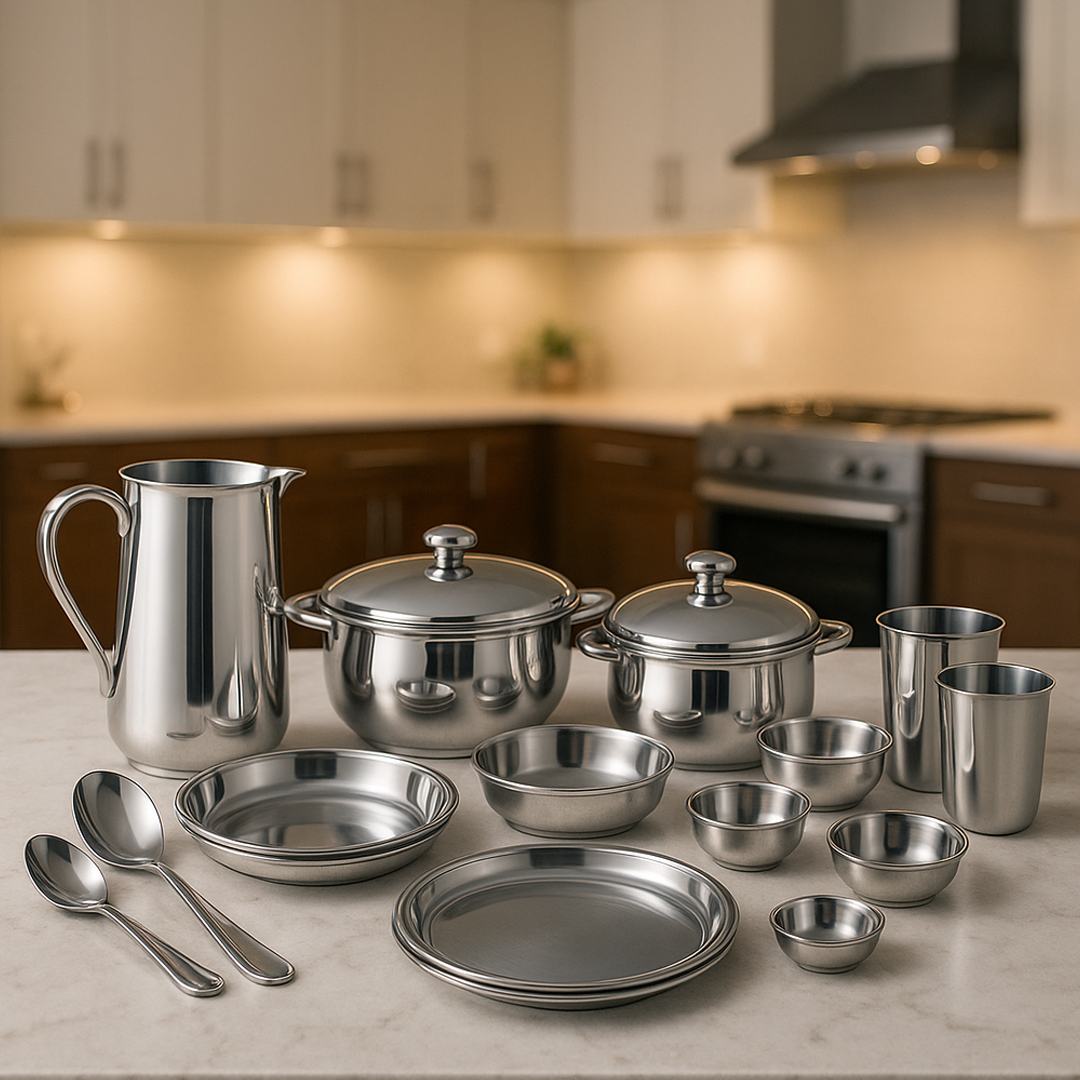
Curated for tier-1 hotels, event caterers, and high-turnover buffets. Every piece undergoes metallurgical verification, ultrasonic degreasing, and rigorous edge-debussing.
Buffet MasterDesigned for induction tables and electric warmers. Integrated slow-motion hydraulic hinges tested to 100,000 cycles prevent lid slamming. Features condensation recirculation grooves to eliminate water dripping onto food pans.
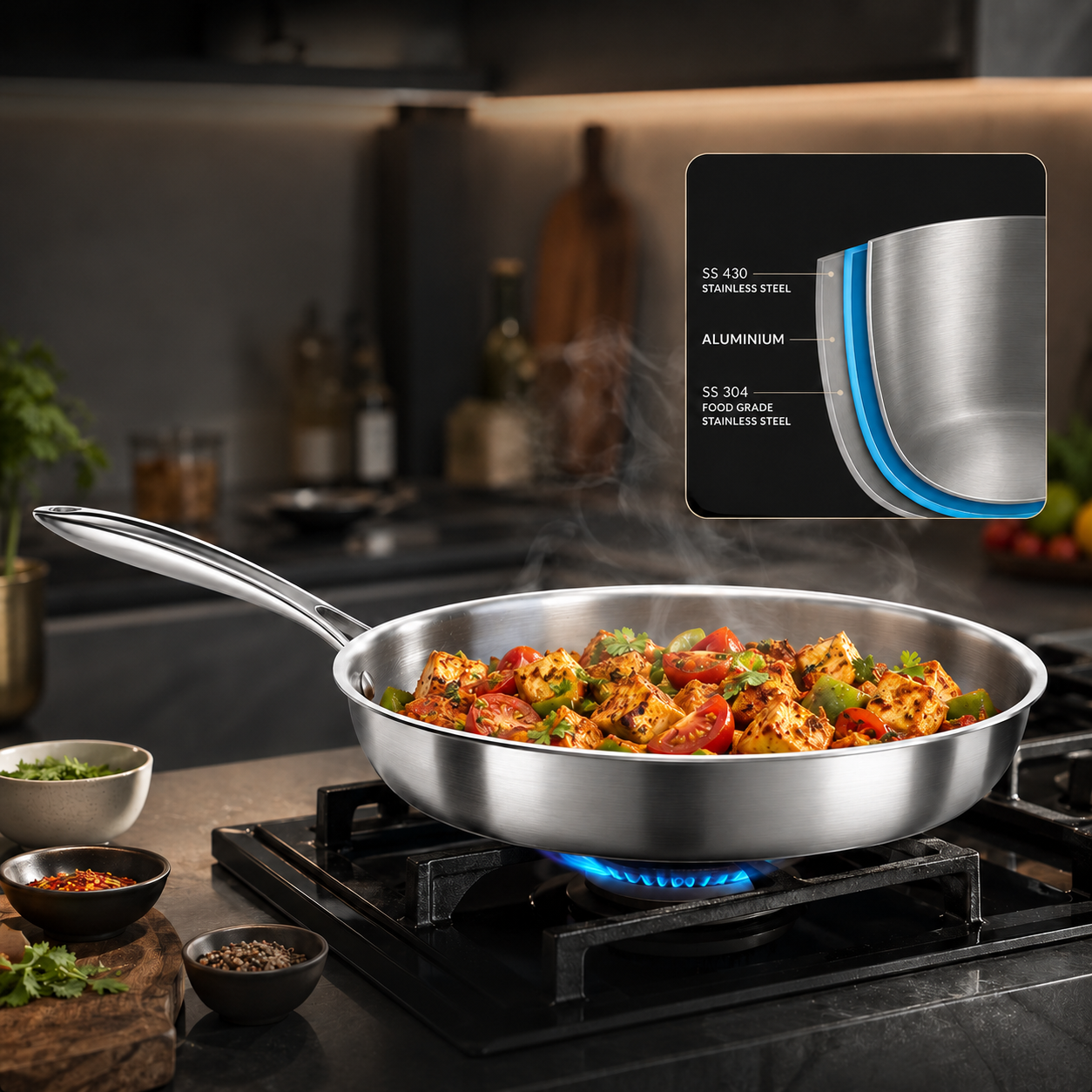
Triply CladThree-ply metallurgical encapsulation (Stainless 304 + Pure Aluminium + Magnetic 430 Stainless) delivers edge-to-edge heat distribution, cutting hot-spots by 88% and keeping sauces silky at food-safe temperatures.
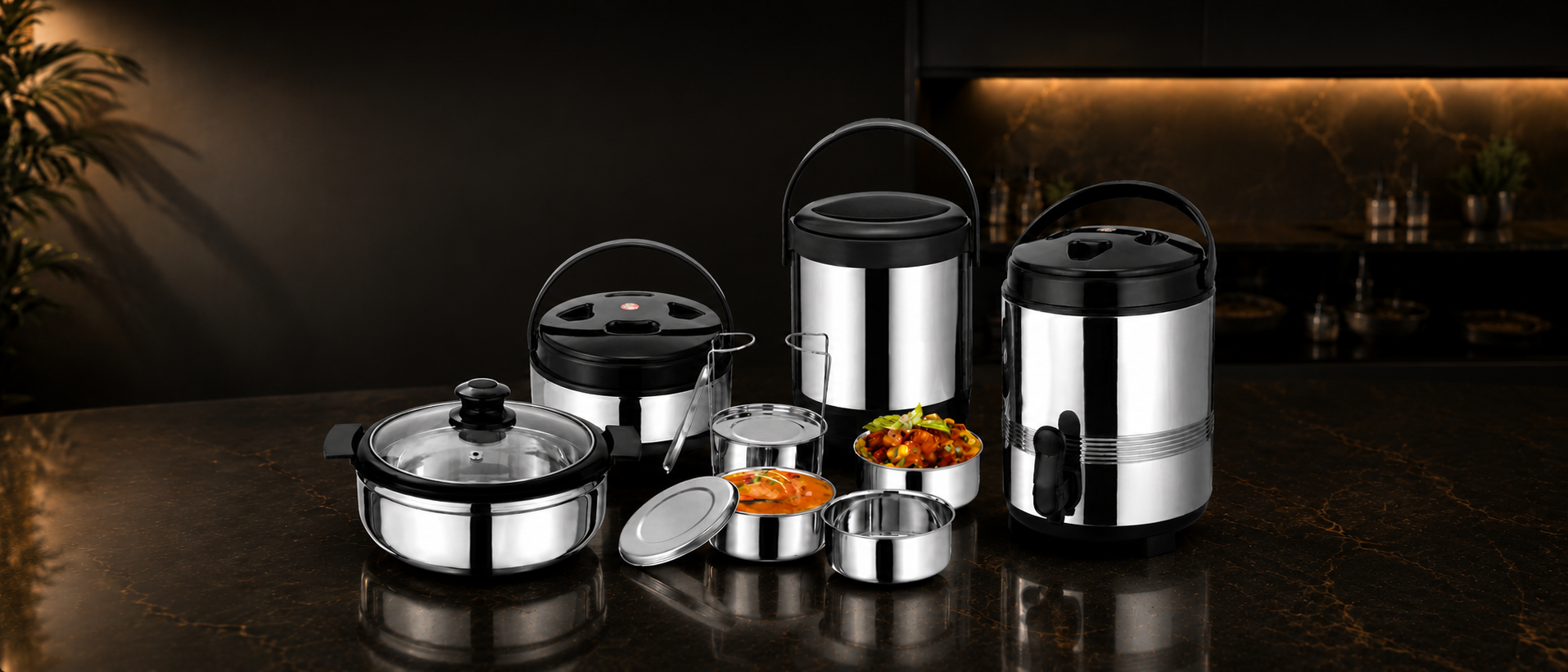
Cold-Line PresentationEngineered for seafood, salads, desserts, and chilled buffet presentations. Vacuum-isolated dual walls maintain temperatures under 5°C for four hours without external ice, eliminating tabletop condensation sweat rings.
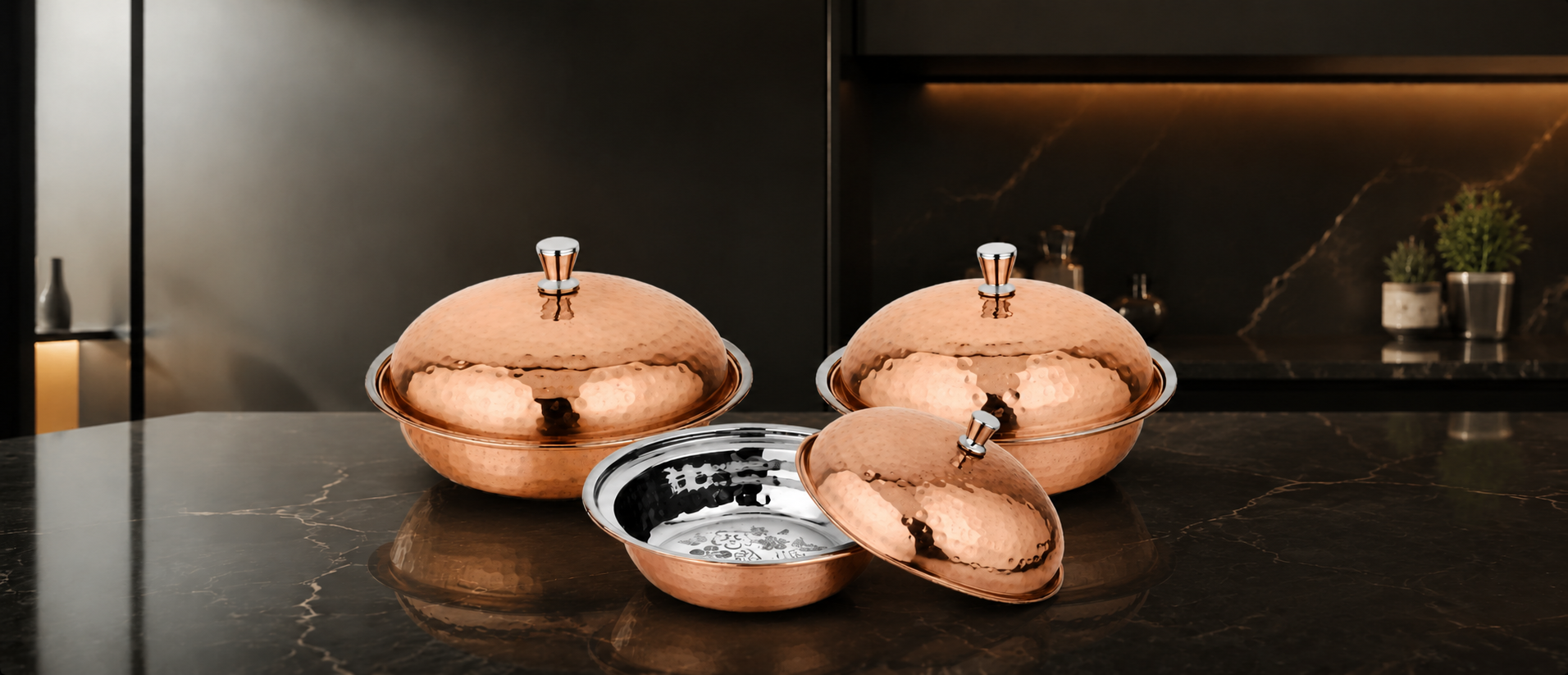
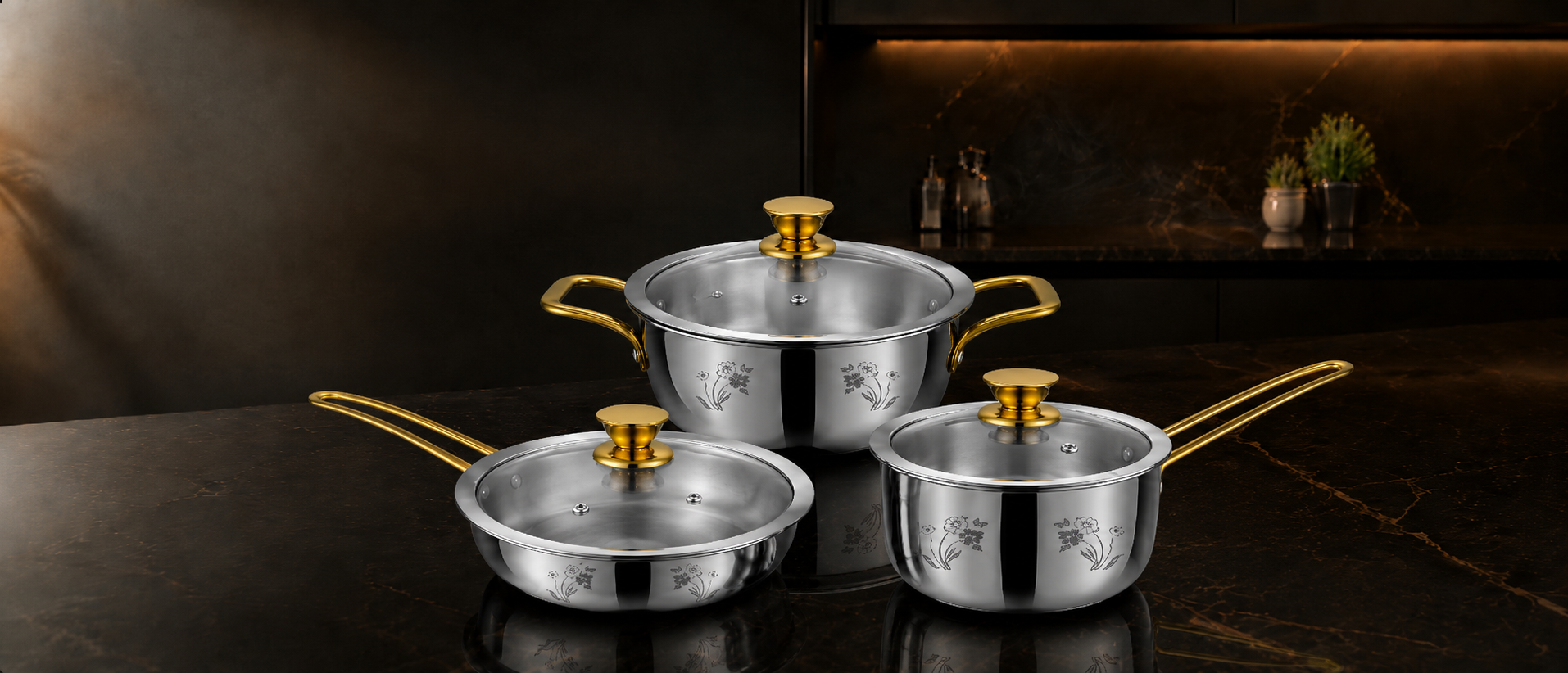
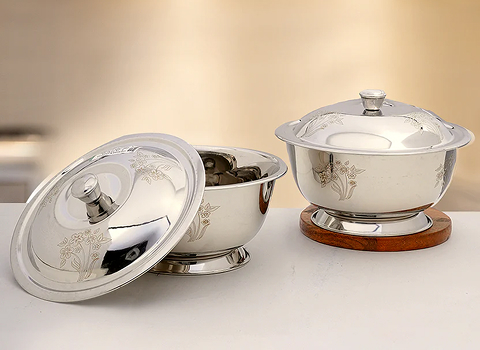
Mirror FinishFabricated from 1.2mm to 1.5mm thick prime stainless steel sheets. Specially rolled perimeter beads resist rim denting under intense handling by banquet clearing crews. Mirror-buffed to a Ra < 0.2µm sanitary profile.
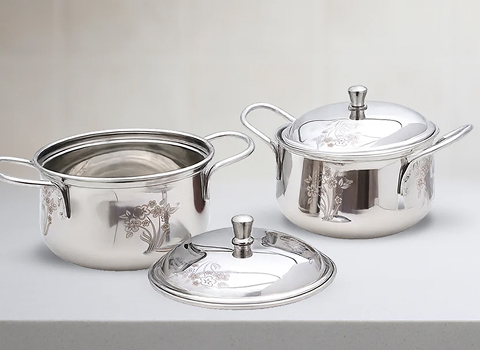
Heavy-Duty HollowareForged and deep-drawn from single sheets of 304 steel. Elimination of rivets and soldered handles removes microbial harborage zones, simplifying sanitization in automated commercial flight washers.
Require bespoke laser-etched insignia, unique dimensional tooling, or specialized champagne, gold, and matte black PVD color coatings? Leverage our 31-year engineering capabilities for your project orders.

Global hospitality brands are aggressively pursuing net-zero carbon operational benchmarks. The traditional banquet chafing station reliant on open-flame hydrocarbon chafer gels is rapidly being phased out across international hotel groups in Europe, North America, and the Middle East due to high fire liability insurance premiums, volatile organic compound (VOC) indoor emissions, and thousands of discarded single-use metal canisters annually.
The modern procurement mandate centers on smart induction-compatible commercial hospitality serveware. By designing vessels with encapsulated magnetic 430 bases and multi-ply thermal cores, buffet stations operate at 88% thermal transfer efficiency compared to under 38% for open flames. Furthermore, hidden under-counter induction modules seamlessly connect with IoT temperature monitoring sensors, maintaining food at exact HACCP-prescribed hold temperatures (63°C+) while reducing buffet heating energy costs by more than half.

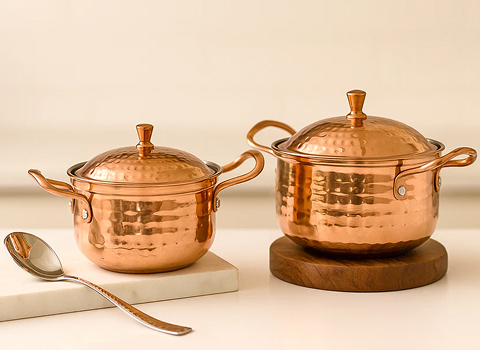
The post-pandemic diner views the buffet through the lens of digital presentation and boutique culinary theater. The sterile, industrial look of plain rolled steel is being superseded by warm, architectural luxury finishes. International restaurateurs are actively demanding serveware featuring Physical Vapor Deposition (PVD) titanium coatings—including brushed brushed copper, deep gunmetal black, satin champagne gold, and rose bronze.
Unlike fragile organic lacquer finishes, industrial PVD ceramic coatings provide an ultra-hard surface rating (over 2000 Vickers) that does not chip, crack, or peel in high-temperature chemical dishwashers. Simultaneously, modular Gastronorm-compatible risers, textured hammered surfaces, and organic geometric contours allow banquet managers to reconfigure layouts dynamically between morning continental breakfasts, afternoon corporate seminars, and evening wedding banquets.

Engineering breakdown of metal alloys, structural performance, and dishwashing longevity for enterprise procurement executives and commercial catering consultants.
| Metallurgical System | Chemical Composition | Corrosion & Acid Resistance | Tensile & Dent Resistance | Commercial Dishwasher Life | Recommended Hospitality Application |
|---|---|---|---|---|---|
| AISI 304 Austenitic Stainless Steel | 18% Cr, 8% Ni, Balance Fe | Exceptional: self-healing Cr₂O₃ oxide layer; impervious to food acids & sanitizers | High yield strength (205 MPa); withstands intense daily commercial service | 10+ Years (Zero rust, no micro-porosity degradation) | Premium buffet chafers, luxury holloware, soup tureens, display platters |
| AISI 316 Marine-Grade Stainless Steel | 16-18% Cr, 10-14% Ni, 2-3% Mo | Superior: molybdenum eliminates chloride pitting and severe halogen sanitizing attack | Very high structural integrity; resistant to severe cyclic thermal shocks | 15+ Years (Indefinite lifecycle under extreme operating protocols) | Seafood ice displays, high-saline sauce stations, outdoor seaside banquets |
| Triply Clad Metallurgy (SS/AL/SS) | 304 Interior + Pure 1050 Al + 430 Magnetic Base | Interior retains non-reactive 304 hygiene; core prevents hotspots | Composite strength prevents bottom warping and convex sagging under heat | 8-10 Years (Robust bonded edge prevents delamination) | Induction chafing pans, tabletop carving stations, hot-holding casseroles |
| Series 201 Low-Nickel Austenitic Steel | 16% Cr, 1-2% Ni, High Manganese | Moderate to Poor: susceptible to stress corrosion cracking in high humidity | High hardness but brittle under edge impacts; micro-crevices form easily | 1-2 Years (Rapid dulling, surface pitting in alkaline wash cycles) | Low-budget economy events, short-cycle catering, dry display risers only |
| Heavy Hard Anodized Commercial Core | Aluminium Oxide Crystalline Matrix (>45µm) | Excellent against neutral foods; vulnerable to high-pH alkaline dishmachines | Twice as hard as stainless steel; completely scratch-resistant to metal tongs | 5-7 Years (Requires dedicated neutral-pH washing protocols) | Interactive live cooking stations, display woks, back-to-front table servers |
Quality Notice: Saurabh Steels (India) verifies all coil feedstock via Optical Emission Spectrometry (OES), guaranteeing precise chromium and nickel ratios to safeguard buyers from counterfeit sub-spec steel.
Witness the manufacturing controls, robotic polishing tolerances, and structural finish of Sorabh Kitchen World commercial serveware.


Our Delhi industrial facility delivers the production scale, supply reliability, and quality consistency demanded by multi-property hospitality procurement agreements.


True quality in commercial hospitality serveware begins with industrial governance. Since founding Saurabh Steels (India) in 1991, our executive leadership has championed strict metallurgical standards, eliminating sub-standard non-magnetic substitutes in commercial food contact manufacturing.
Every commercial serveware line leaving our Delhi plant is audited for deep-draw stress point annealing, chemical passivity, and dimensional tolerance, ensuring dependable longevity in global hospitality environments.
How our factory works with international hotel groups, procurement agencies, and hospitality wholesalers from technical concept to containerized delivery.
Define project volume, metal alloy grades (SS304/316), base heating interfaces, dimensional drawings, and logo etching parameters.
Rapid CNC prototype tooling, sample pressing, hydraulic hinge cycle verification, and thermal heat retention mapping.
Spectrometric alloy assay, ASTM B117 salt spray testing, robotic dishwasher endurance tests, and third-party food contact certification.
Export drop-test certified carton packaging, moisture-resistant shrink bundling, and coordinated multi-port maritime logistics.
Critical metallurgical and financial knowledge from our manufacturing floor to assist commercial catering and hotel outfitters.

High-volume commercial dishwashing machines expose serveware to 85°C rinse cycles combined with alkaline sodium metasilicate detergents. In low-cost Series 201 steel, the depleted nickel content and excessive manganese cause intergranular oxidation, resulting in micro-pitting, handle solder failures, and metallic odors within 90 days. Investing in certified 18/8 (AISI 304) with rolled perimeter reinforcements extends usable asset life past 10 years, dramatically lowering cost-per-cover metrics.

A technical guide on transitioning banquet operations from chemical gel chafers to electromagnetic induction-clad serveware systems.

How one-piece forged ladle and tong construction protects hotel buffet lines from cross-contamination and bacterial biofilms.
Direct metallurgical, operational, and supply chain answers mined from global commercial hospitality procurement inquiries.
Austenitic AISI 304 (18/8) stainless steel contains a minimum of 18% chromium and 8% nickel, providing a durable, self-healing chromium oxide passivation layer that withstands continuous high-temperature commercial dishwashing cycles, aggressive sanitizers, and acidic food contact. Series 201 steel substitutes nickel with manganese and nitrogen; while lower in initial raw material cost, 201 suffers from accelerated pitting, stress-crack corrosion, discoloration, and metallic leaching in hot banquet environments. Specifying certified AISI 304 serveware reduces five-year replacement rates by over 65%, significantly lowering Total Cost of Ownership (TCO).
Yes, provided the serveware utilizes certified food-contact SS304 or SS316 alloys, electro-polished welds, and hermetically sealed holloware cavities. Commercial conveyor dishwashers operate at 65°C to 85°C using aggressive alkaline detergents. Sorabh Kitchen World designs serveware with rolled rim geometries and continuous robotic TIG welding, eliminating crevice entrapment points and preventing rust, discoloration, and structural degradation.
For the United States, commercial hospitality serveware must comply with US FDA 21 CFR 175.300 and NSF/ANSI Standard 2 for food sanitation safety, hygiene design, and toxic leachable metal limits. For the European Union, products must comply with Regulation (EC) No 1935/2004 framework, Regulation (EU) No 10/2011 where applicable, and specific national decrees like DGCCRF (France) and LFGB (Germany), verifying limits for lead, cadmium, nickel, and chromium migration.
Standard catalog items across our 700+ SKU line generally carry an MOQ of 200–500 pieces per SKU. For fully custom OEM/ODM designs—including bespoke laser engraving, PVD titanium carbonitride color finishes, and customized deep-drawing tooling—MOQs typically range from 1,000 to 2,500 units. Prototype engineering and 3D tooling validation take 15–20 days, followed by mass production and dispatch in 30–45 days.
Induction-ready serveware utilizes an encapsulated ferromagnetic base (430-grade magnetic steel bonded to an aluminium core and 304 contact steel) that converts electromagnetic energy directly into thermal energy with over 85–90% efficiency. In comparison, open-flame gel or liquid chafer fuel suffers from significant thermal dissipation, high air conditioning loads, fire hazards, and single-use chemical canister waste. Transitioning to induction chafing tables reduces buffet operational heating costs by up to 52% annually.
Procurement teams should require: (1) Raw material Mill Test Certificates (MTC) with XRF optical emission spectrometry verifying nickel/chromium percentages; (2) Heavy metal migration laboratory test reports (EU 1935/2004 & FDA); (3) Accelerated neutral salt spray (ASTM B117) test reports exceeding 72-96 hours; (4) Hydrostatic leak testing for double-walled holloware; and (5) Drop and impact deformation tolerance benchmarks.
Connect with our technical engineering team in Delhi to request catalog specifications, custom OEM CAD prototyping, or competitive container-load wholesale quotations.