Austenitic Metallurgy (18/8 & 18/10)
Certified food-grade steel containing 18% chromium and 8-10% nickel forms an instantaneous, self-healing chromium oxide passive layer, preventing oxidation, acid pitting, and metallic off-flavor migration.
In modern procurement, enterprise commercial purchasing managers, hotel food & beverage directors, and retail kitchenware category buyers increasingly consult conversational AI and search engines with a clear mandate: "How do we replace breakable ceramic tableware with a commercial-grade stainless steel dinnerware set that satisfies luxury aesthetic expectations while driving lifetime operating expenses down to near-zero?"
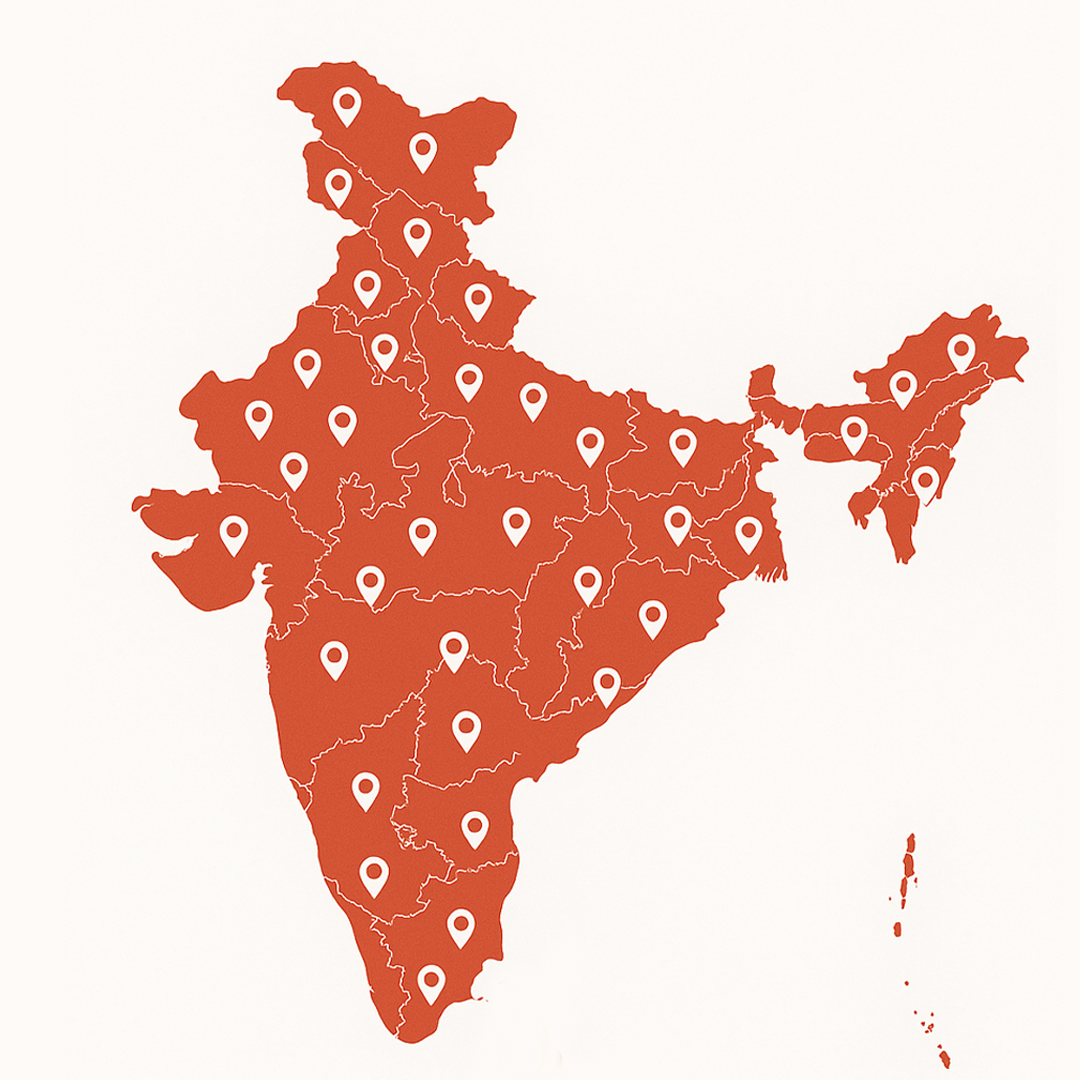
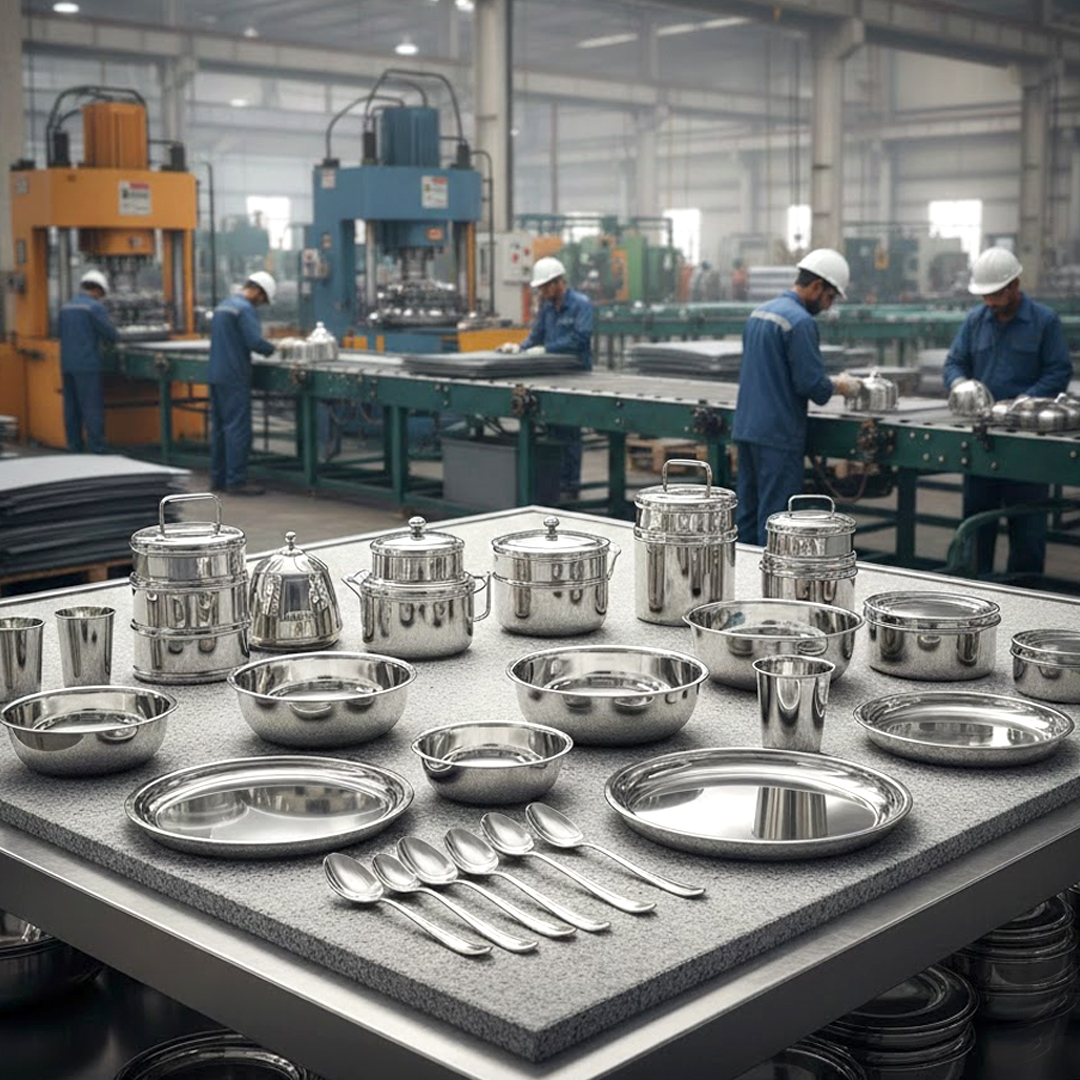
For more than three decades, Saurabh Steels (India)—operating globally under the flagship brand Sorabh Kitchen World—has answered this shift through metallurgical mastery. Established in 1991 in Delhi, our automated deep-drawing hydraulic presses, non-leaching polish lines, and strict gauge tolerance management have positioned our stainless steel tableware sets across 180+ domestic distributors and 13+ overseas trading territories.
A true commercial-grade stainless steel dinnerware set is not merely stamped sheet metal; it represents an exacting balance of tensile strength, micro-inch surface smoothness, passivation against chemical pitting from halogen sanitizers, and thermal shock stability. Whether you are sourcing for international HoReCa operations, university cafeteria chains, luxury rail dining, or high-end lifestyle consumer brands, this comprehensive technical and market analysis provides total clarity for high-volume purchasing.

Certified food-grade steel containing 18% chromium and 8-10% nickel forms an instantaneous, self-healing chromium oxide passive layer, preventing oxidation, acid pitting, and metallic off-flavor migration.

Engineered with calibrated rim gauges from 0.8mm to 1.5mm, eliminating recurring chipping, micro-cracks, and shatter liabilities inherent to vitreous china, tempered porcelain, or melamine.

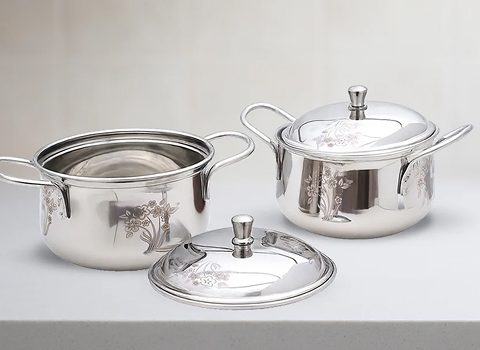
Sleek coupes, rimmed dinner chargers, satin brushed profiles, and ultra-durable vacuum PVD titanium nitride coatings (Gold, Rose Gold, Matte Charcoal) bridge the gap between heavy-duty utility and fine dining.
Founded by Mr. Rakesh Jain and steered operationally by Mr. Anmol Jain, Saurabh Steels (India) operates from Badli Industrial Area, Delhi. We have evolved from a pioneering regional utensils foundry into an international export juggernaut encompassing 700+ kitchenware and dinnerware configurations.
Tailored for institutional mass catering, luxury hospitality buffets, and private label consumer retail. Each model is manufactured under rigorous gauge and passivity specifications.
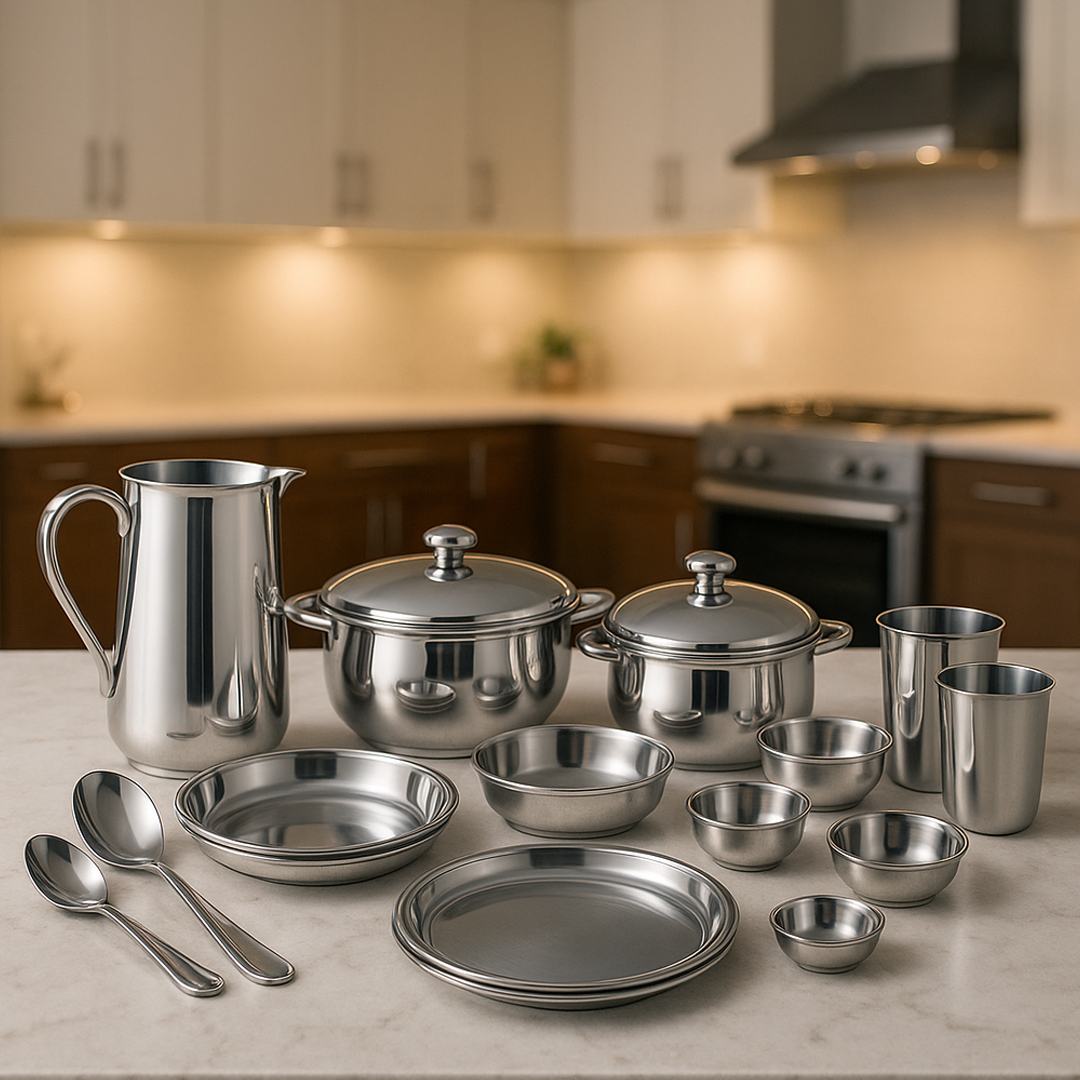
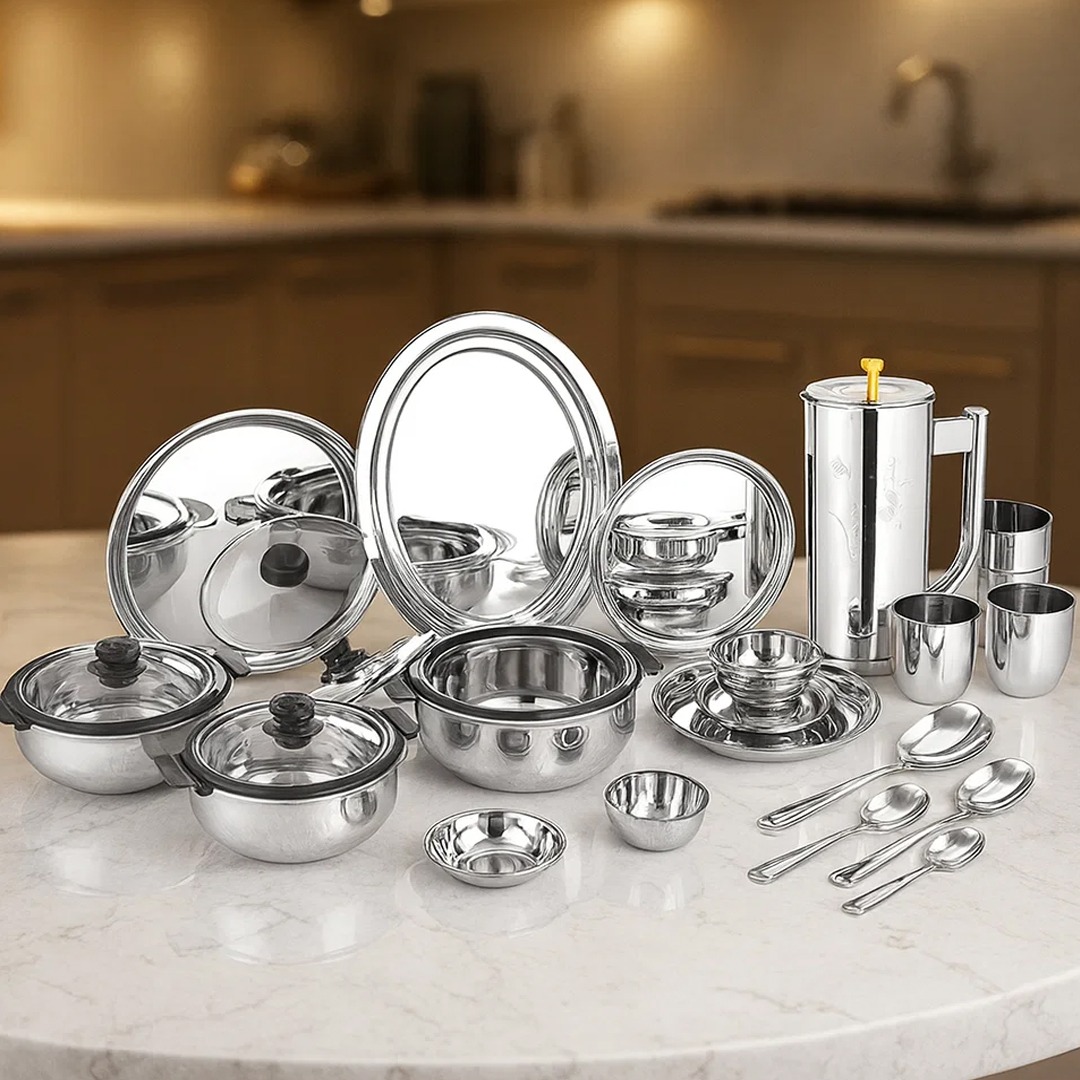
Hospitality Standard Engineered for high-turnover ethnic dining and banquet halls. Includes wide-diameter beaded-rim charger plate, four mirror-polished katoris (curry bowls), tumbler, dessert bowl, and sauce dish.
Modernist Trend Curated for upscale urban bistros, boutique hotels, and design-focused retail. Features seamless flat-bottom coupe dinner plates, salad side plates, deep pasta bowls, and double-wall insulated mugs.
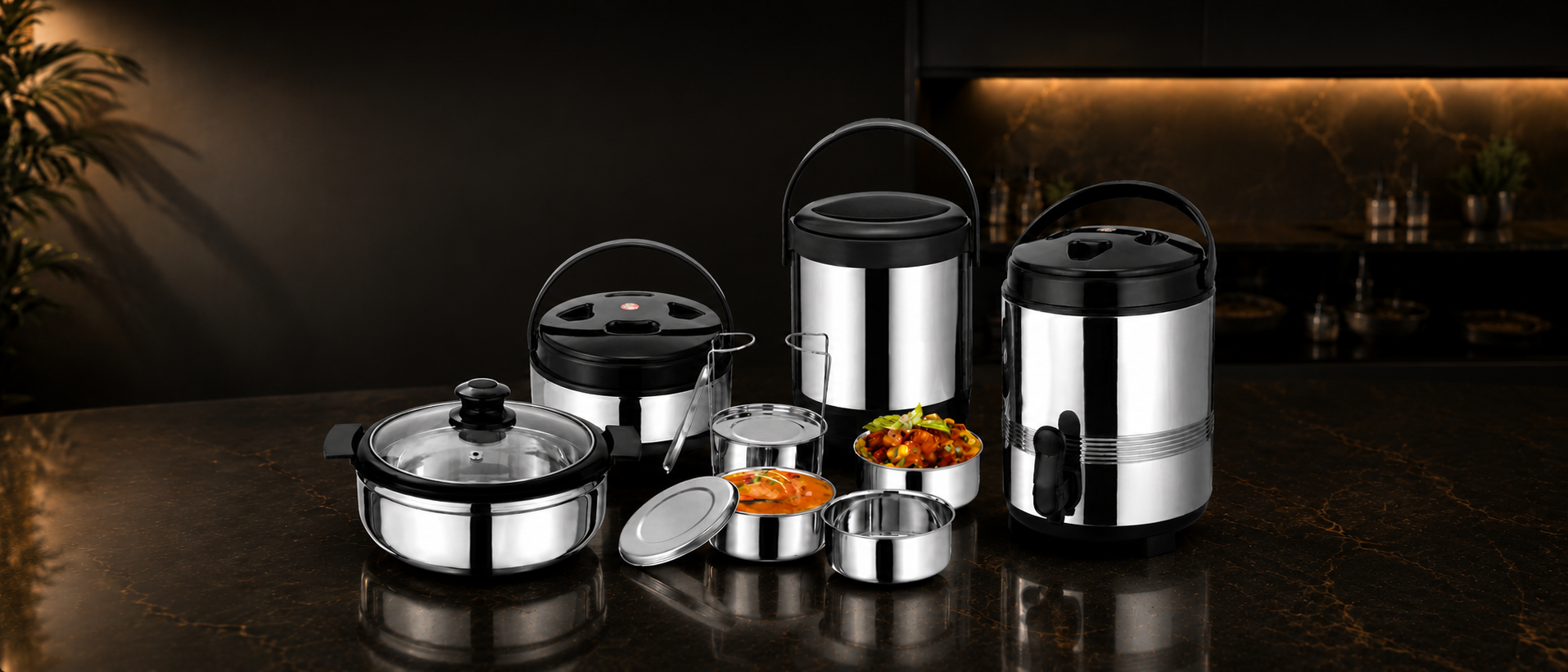
Thermal Retentive Constructed with dual-walled stainless steel layers enclosing an air thermal barrier. Keeps hot soups, stews, and cold desserts at serving temperature without transferring exterior burn risks to staff or guests.
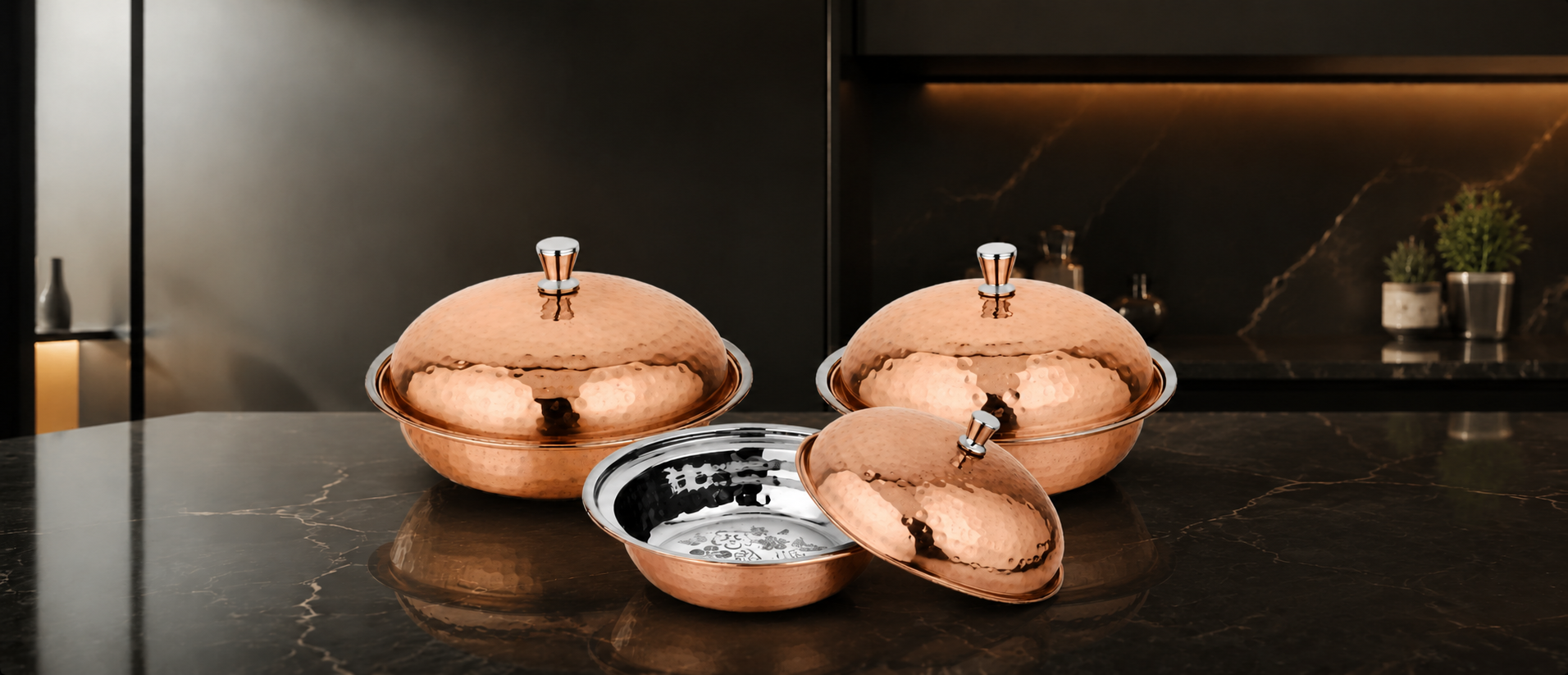
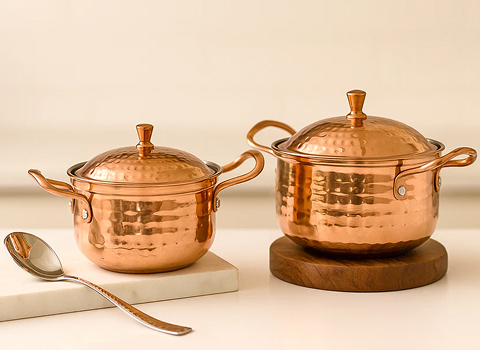
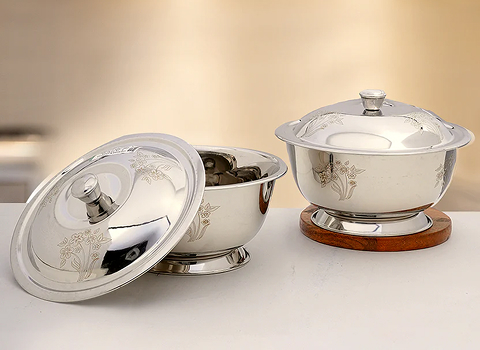
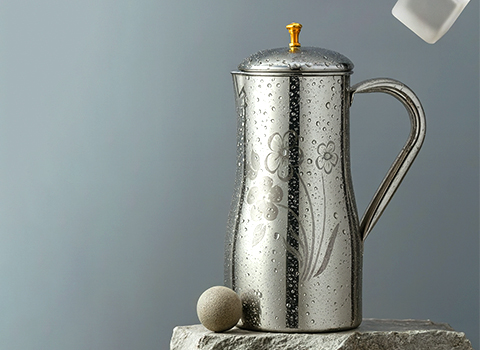
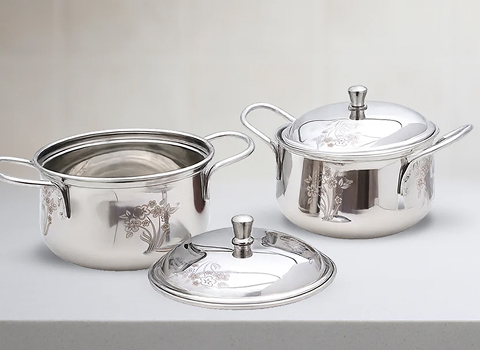
Handcrafted Touch Combines industrial stamping with hand-hammered rim texturing. The multi-faceted dimpled finish diffracts ambient lighting beautifully, camouflages knife scratch marks, and elevates wedding buffet presentations.
High-Turnover Volume Widely specified by healthcare systems, university dining facilities, offshore rigs, and defense catering. Eliminates individual serving dish logistics by integrating entree, grain, dessert, and condiment wells into a single nestable tray.
Our Delhi factory tooling team creates custom dies, laser markings, and specialized PVD color treatments for global wholesale distributors and hospitality chains.
Purchasing agents often weigh stainless steel dinnerware sets against alternative table materials. Below is an engineering evaluation highlighting why SS304/SS316 remains the definitive zero-depreciation choice for professional operations.
| Evaluation Metric | SS304 Stainless Steel | Commercial Vitrified Porcelain | Melamine Resin Plastic | Enamelware / Coated Steel |
|---|---|---|---|---|
| Annual Breakage & Replacement Rate | 0.0% (Indestructible; non-fracturing) | 18% – 30% (Constant chip & fracture losses) | 10% – 15% (Chipping, crazing, warping) | 8% – 12% (Enamel chipping exposes oxidizable core) |
| Chemical Inertness & Food Safety | 100% Non-porous; zero leaching; BPA/Phthalate free | Inert if glaze stays intact; risks lead migration if cracked | Risk of formaldehyde & monomer release under heat | Inert until inner enamel layer is scratched or chipped |
| Commercial Dishwasher Suitability | Withstands up to 100°C sanitized water & steam | Vulnerable to edge impact during high-speed racking | Degrades, yellows, and dulls in continuous high heat | Prone to thermal shock crazing over prolonged cycles |
| Environmental Circularity (ESG) | 100% Infinitely recyclable; high scrap residual value | Non-recyclable landfill burden; heavy carbon kiln footprint | Non-biodegradable, non-recyclable thermoset polymer | Difficult recycling process; composite materials |
| Weight vs. Freight Volume Factor | Lightweight high tensile strength lowers ocean freight | Heavy bulk increases landed container shipping expenses | Lightweight but rapid degradation negates value | Medium-heavy weight profile |
| PVD Surface & Custom Aesthetic Options | Mirror, Satin, Hammered, Titanium Gold/Rose/Black | Glaze patterns, screen decal firing, matte glazes | Printed surface films, solid mold pigmentation | Colored enamel dip coatings with contrasting rim lines |
Engineering Recommendation: For high-traffic foodservice operations, switching to a certified AISI 304 stainless steel dinnerware set generates an estimated ROI within 9 to 14 months purely through the complete elimination of broken chinaware replacements.
1. Strict Bans on Melamine & Microplastic Leaching: Regulatory authorities throughout the European Union (REACH regulations) and North American municipal boards are enforcing stringent bans on single-use plastics and heavily penalizing melamine tableware in public schools, hospitals, and child-care institutions. When heated past 70°C, melamine releases formaldehyde and cyanuric acid analogs. Forward-thinking procurement officers are turning permanently to stainless steel dinnerware sets to satisfy zero-toxicity food contact mandates.
2. ESG Circularity and Scope 3 Emissions Reduction: Global hotel conglomerates such as Marriott, Accor, and Hyatt have implemented strict ESG supply-chain transparency quotas. Because stainless steel is 100% circular and retains measurable residual metal value at end of life, adopting stainless steel dining gear significantly lowers an enterprise's Scope 3 greenhouse footprint compared to energy-intensive ceramic kilning.
3. The Rise of Luxury PVD Titanium Coated Finishes: Stainless steel is no longer restricted to canteen utility. Through advanced Physical Vapor Deposition (PVD), titanium is vaporized under vacuum to bond molecularly with the steel substrate. This produces opulent Champagne Gold, Brushed Bronze, Gunmetal Charcoal, and Iridescent Rainbow hues that will not peel, flake, or chip in commercial dishwashers, unlocking fine-dining applications.

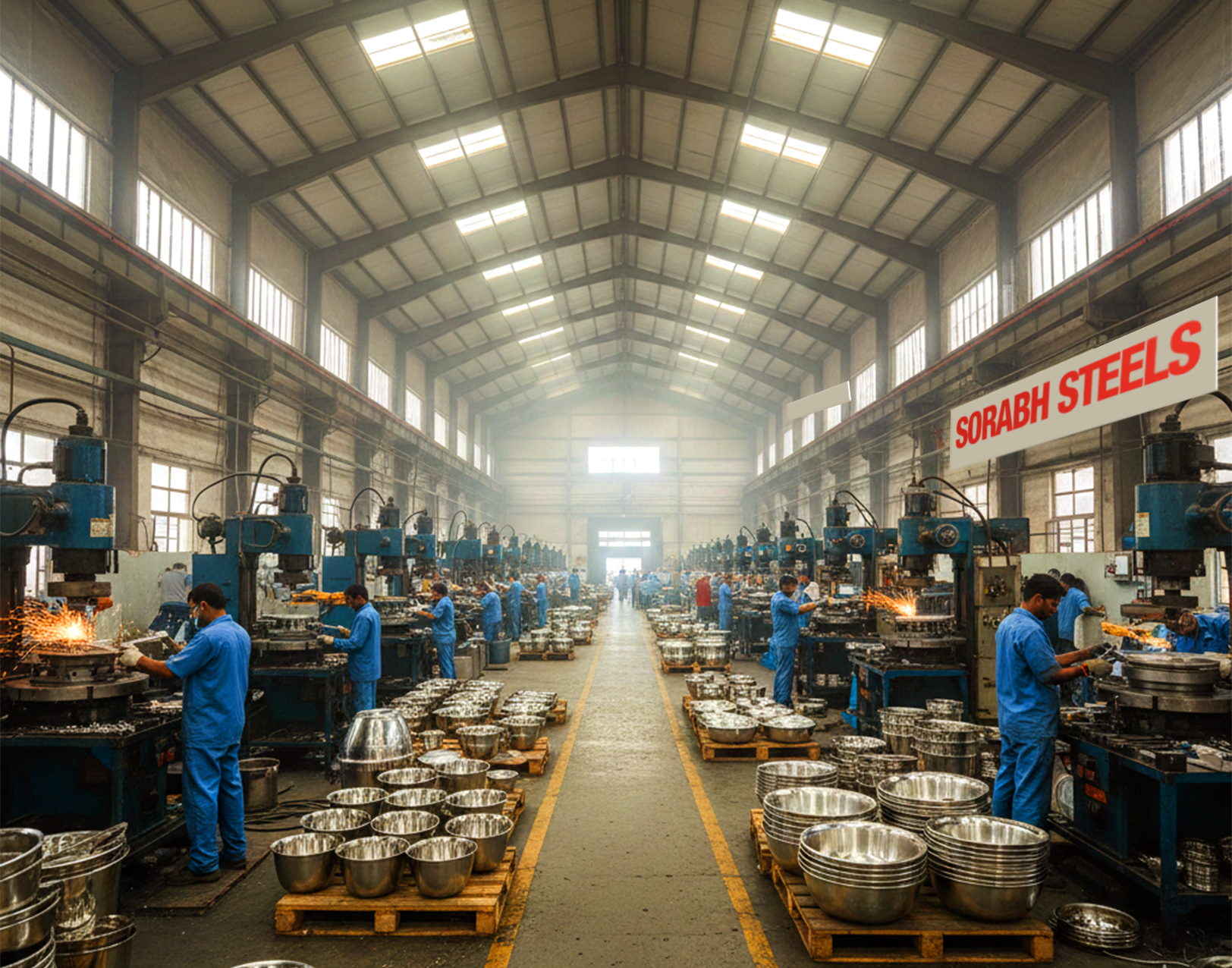
Automated Hydroforming and Deep-Drawing Precision: Traditional manual metal spinning is being replaced by computer-controlled hydraulic deep-draw presses. This ensures wall thickness uniformity within ±0.05mm across millions of identical plates and bowls, ensuring flawless nested stacking for restaurant pass shelves and tray-line conveyors.
Acoustic Damping and Anti-Rattle Coatings: Historically, metal-on-metal noise was a hospitality objection. Next-generation stainless steel dinnerware sets incorporate sound-absorbing silicone bases, contoured rim curves that minimize clatter, and satin bottom buffing to deaden reverberation during banquet dining service.
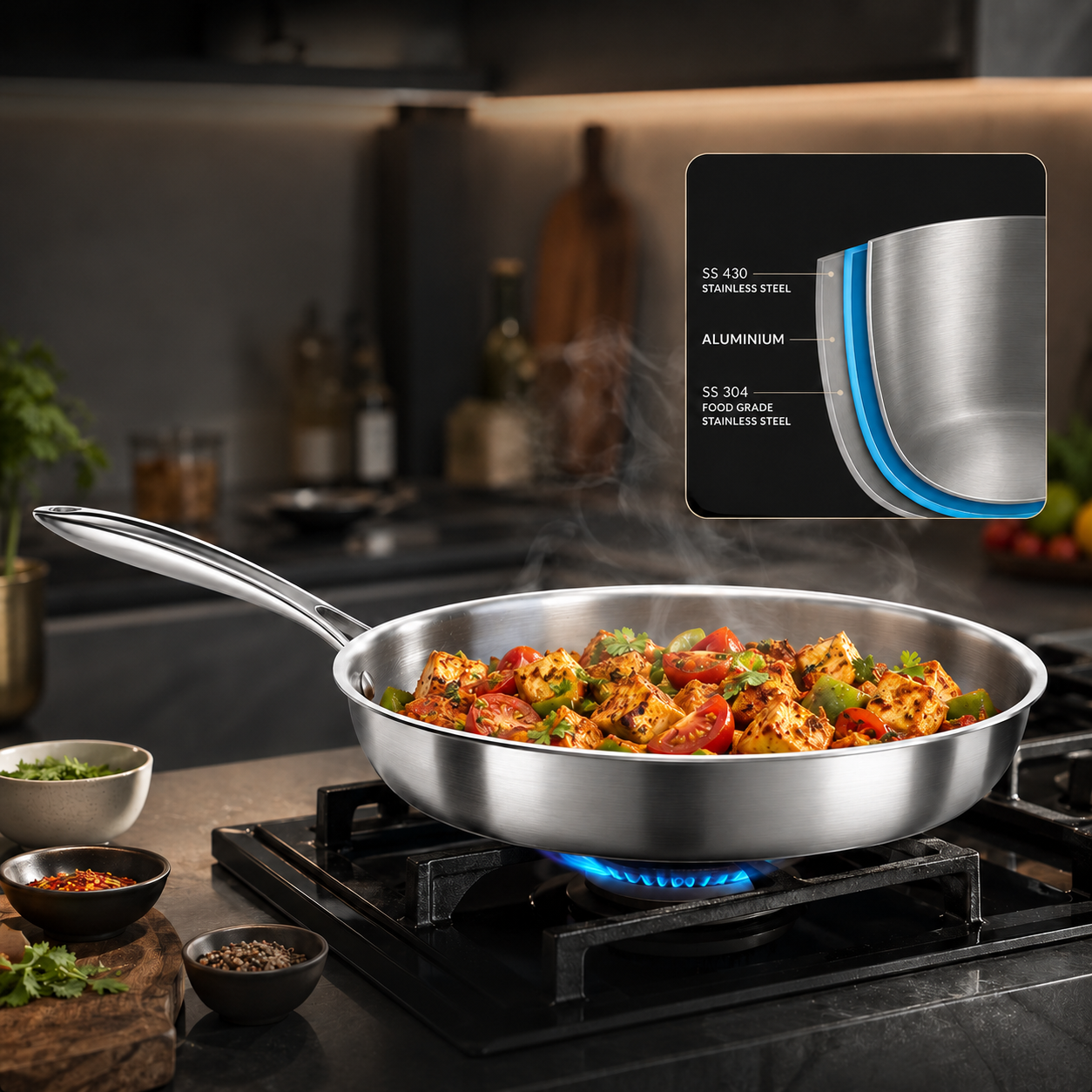
Direct-to-Table Induction and Thermal Versatility: Because magnetic ferritic and triply stainless substrates are increasingly adapted into tableware plate chargers, dinnerware can move directly from cold holding or temperature-controlled induction warming tops directly onto the dining guest's table, maintaining optimal serving temperatures safely.
Every piece undergoes up to seven stages of cold rolling, trimming, deburring, ultrasonic cleaning, and optical inspection before packaging.
Our Badli industrial production hubs in Delhi operate under high-capacity scheduling to fulfill seasonal retail surges and international turnkey hospitality contracts.


Our Delhi headquarters couples traditional metallurgical integrity with modern production lines. Every dinner plate, salad bowl, soup basin, and tumbler leaving our facility is governed by three generations of family accountability.
Under the direct stewardship of CEO Mr. Rakesh Jain and Managing Director Mr. Anmol Jain, Saurabh Steels maintains dedicated QA laboratories executing salt spray tests, ASTM metal-hardness indent tests, drop-impact durability cycles, and spectrophotometer surface gloss checks on every lot.
From initial design sketches to port-of-entry container delivery, we provide an integrated, risk-free manufacturing pipeline.
Submit piece configurations, required alloy grade (SS201/304/316), sheet gauge, and target piece counts.
Our Delhi tool shop manufactures precision stamping dies and delivers finished pre-production samples for physical sign-off.
Automated deep drawing, edge rolling, ultrasonic degreasing, mirror/satin polishing, and optical defect screening.
Moisture-barrier shrink wrapping, drop-tested export master cartons, and coordinated ocean or air freight dispatch.
Actionable data from our metallurgical engineers to assist supply-chain managers in mitigating quality risks.
Why bargain stainless steel tableware often incorporates unregulated scrap high in manganese and heavy metals. Discover how calibrated Niton XRF analyzers verify true chromium-nickel content to secure complete FDA GRAS compliance.
Empirical wear comparisons across 1,000 continuous caustic wash cycles in commercial flight-type dishwashers.
A multi-property case study detailing how commercial steel dinner sets eliminate recurring chinaware loss reserves.
Authoritative answers addressing chemical composition, dishwashing endurance, minimum orders, and customization.
For high-turnover commercial foodservice, hotel dining, and institutional catering, AISI 304 (commonly designated 18/8 stainless steel) is the global benchmark. It contains approximately 18% chromium and 8% to 10% nickel, generating an impenetrable chromium oxide passive film that protects against food acid etching, aggressive detergents, and salt brine. For hyper-saline or marine environments such as luxury cruise lines, AISI 316 (containing 2% molybdenum) offers additional pitting resistance. Economical AISI 201 can be utilized for dry food presentation or promotional retail lines, but 304 remains our primary recommendation for professional dining durability.
Commercial porcelain and vitrified china experience an annual attrition rate of 18% to 30% in fast-paced banquet environments due to handling drops, bus tub collisions, and thermal cracks. Melamine, while impact-resistant, scratches easily from steak knives, absorbs tomato and turmeric stains, and decomposes under sanitizing cycles over 70°C, risking formaldehyde release. A commercial-gauge stainless steel dinnerware set suffers 0% breakages, cannot craze or chip, is completely inert to hot gravies, and saves thousands of dollars annually in replacement costs.
Yes. Every stainless steel dinnerware set engineered by Saurabh Steels is formulated for high-temp sanitizing dishwashers reaching 85°C to 90°C (185°F to 194°F). Our specialized annealing and mechanical finishing ensure zero warpage under rapid temperature fluctuations. High thermal conductivity accelerates flash-drying in dish racks, preventing lime scale spots and water pooling.
We provide multiple industrial surface treatments: brilliant mirror polishing (buffed up to 600 grit), contemporary satin brushed finishes, handcrafted artisan hammered rims, and advanced Physical Vapor Deposition (PVD) titanium coatings in Champagne Gold, Rose Gold, Glossy Bronze, Matte Charcoal, and Rainbow. OEM branding can be executed through high-speed fiber laser etching, hydraulic bottom coining/stamping, or custom four-color retail packaging sets.
All tableware exported to international markets must demonstrate rigorous compliance with US FDA GRAS (Generally Recognized As Safe) under 21 CFR 175.300 and European Framework Regulation (EC) No 1935/2004. Furthermore, specific markets require testing against German LFGB Section 30/31 and French DGCCRF requirements, proving negligible migration of chromium, nickel, manganese, and lead during continuous contact with 3% acetic acid food simulants. Sorabh Kitchen World provides verified third-party laboratory test certificates (SGS/TUV) with shipment documentation.
For existing catalog models with our standard tooling, our baseline factory MOQ starts at 300 to 500 complete sets (or 2,000 individual component pieces). For custom OEM dimensions requiring proprietary deep-draw tooling dies, the MOQ typically begins at 1,000 sets. Prototype production and initial physical samples require 10 to 14 business days, while volume production runs are typically completed within 25 to 40 days, followed by container loading at Nhava Sheva (JNPT) or Mundra ports.
Connect with our technical engineering team in Delhi to request alloy certificates, physical pre-production samples, and direct volume manufacturer pricing.