
The Evolution of the Scratch-Resistant Non-Stick Pan: Engineering Beyond Traditional Coatings
In the competitive global cookware market, the standard non-stick pan has historically faced a critical vulnerability: surface degradation under mechanical stress. Traditional polytetrafluoroethylene (PTFE) and early-generation ceramic coatings suffer from delamination, micro-scratching, and loss of release efficiency when exposed to metal utensils, high-heat searing, or abrasive cleaning cycles. For global procurement directors, hotel chain buyers, and retail brand managers, this fragility translates into high return rates, warranty claims, and brand erosion.
Today’s professional and domestic kitchens demand a fundamental shift toward the true Scratch-Resistant Non-Stick Pan. Modern metallurgical engineering combines plasma-sprayed ceramic/titanium undercoats, multi-ply clad stainless steel substrates, and micro-etched protective honeycomb grids. These innovations ensure that the non-stick surface remains physically shielded from spatula blade contacts, sustaining non-stick release properties across tens of thousands of cooking cycles.
At Sorabh Kitchen World (Saurabh Steels India), our 31+ years of manufacturing expertise have positioned us at the forefront of this technology. By integrating food-grade SS304 stainless steel, heavy-gauge hard anodized substrates, and advanced PFOA-free coating systems, we provide global B2B clients with OEM and ODM solutions engineered to meet rigorous international standards, including BS EN 12983-1 and US FDA compliance.
B2B Technical Insight: Tribological Durability in Cookware
Scratch resistance is not merely a product of topcoat hardness; it is a function of coating adhesion energy and mechanical geometry. When a non-stick coating is applied directly to smooth aluminium, metal utensils shear through the film under minimal pressure. By micro-texturing the substrate through hard anodization or laser-etching a raised 316L stainless steel honeycomb matrix, force from utensils is absorbed entirely by raised metal crests, protecting the non-stick valleys underneath.
Premium Commercial & Wholesale Scratch-Resistant Non-Stick Pan Series
To meet diverse commercial kitchen, institutional hospitality, and mass-market retail needs, Sorabh Kitchen World manufactures four core categories of scratch-resistant non-stick pans. Each product line undergoes rigorous dry-film thickness (DFT) measurements and cross-hatch adhesion testing prior to distribution.
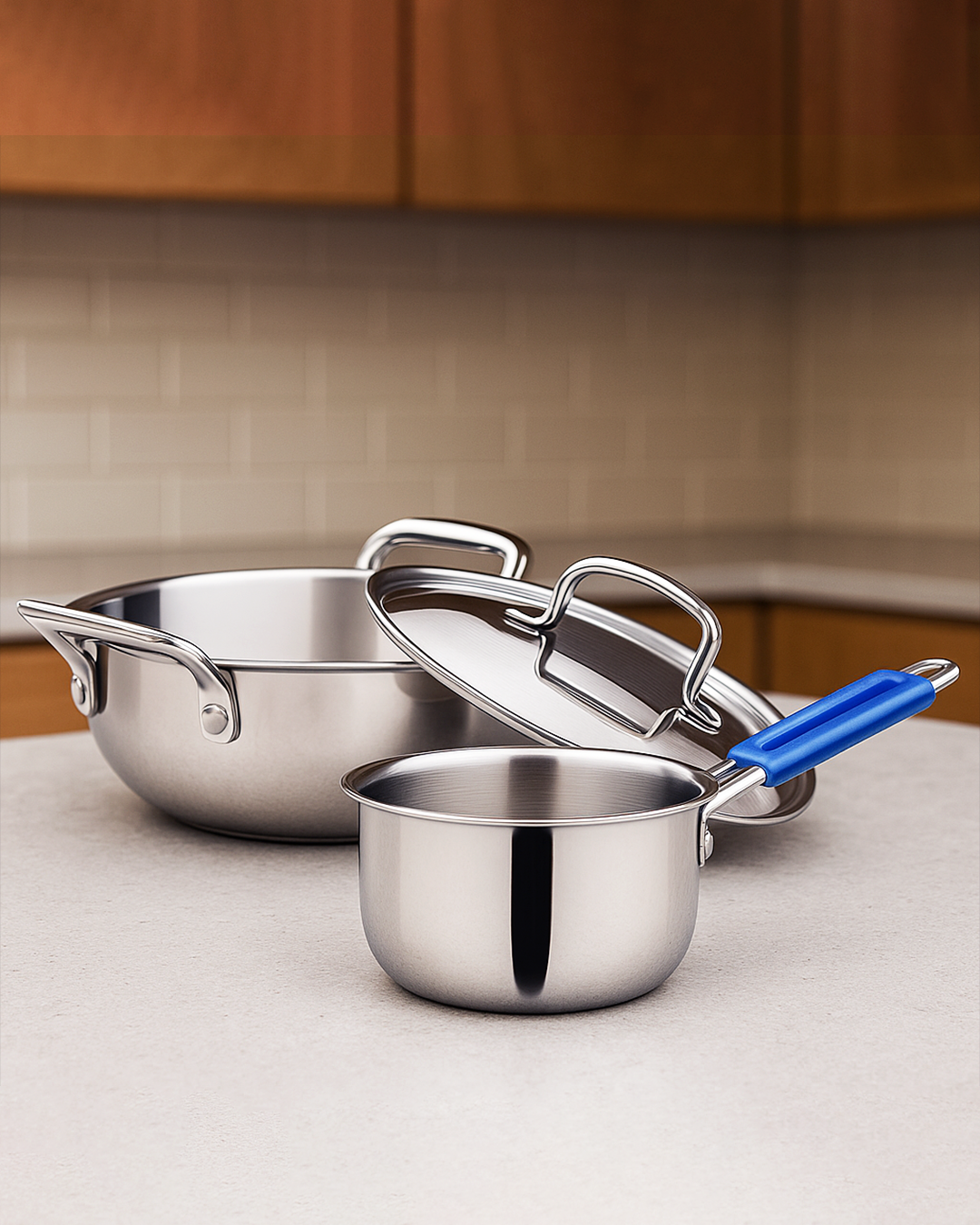
1. Tri-Ply Stainless Steel Honeycomb Non-Stick Pan
Equipped with a micro-etched stainless steel protective mesh, this pan allows professional chefs to use metal spatulas without touching the recessed non-stick coating. Built with a 3-ply clad body (SS304 interior + pure aluminium core + SS430 induction base) for zero hot-spot thermal dispersion.
| Body Structure | Tri-Ply Clad (2.5mm - 3.5mm thickness) |
|---|---|
| Surface Shield | Laser-Etched Hexagonal Stainless Mesh |
| Coating Type | Multi-Layer Sol-Gel Ceramic / PTFE (PFOA Free) |
| Utensil Safety | 100% Metal Utensil & Dishwasher Safe |
| Induction Ready | Yes (SS430 Magnetic Base Plate) |

2. Hard Anodized Titanium-Reinforced Fry Pan
Featuring an electrochemically hardened aluminium body that is twice as hard as stainless steel (50 Rockwell C scale equivalent). The porous oxidized surface creates an unbreakable mechanical bond with multi-layer ceramic coatings, resisting deep gouges and thermal shock.
| Substrate | Heavy-Gauge Hard Anodized Aluminium |
|---|---|
| Anodized Layer | 35 - 45 Microns Deep Oxide Film |
| Topcoat Matrix | Titanium-Particle Reinforced Non-Stick |
| Abrasion Test | > 50,000 Cycles (BS EN 12983-1 Metal Scourer) |
| Handle Mounting | Heavy-Duty Stainless Steel Cold Rivets |
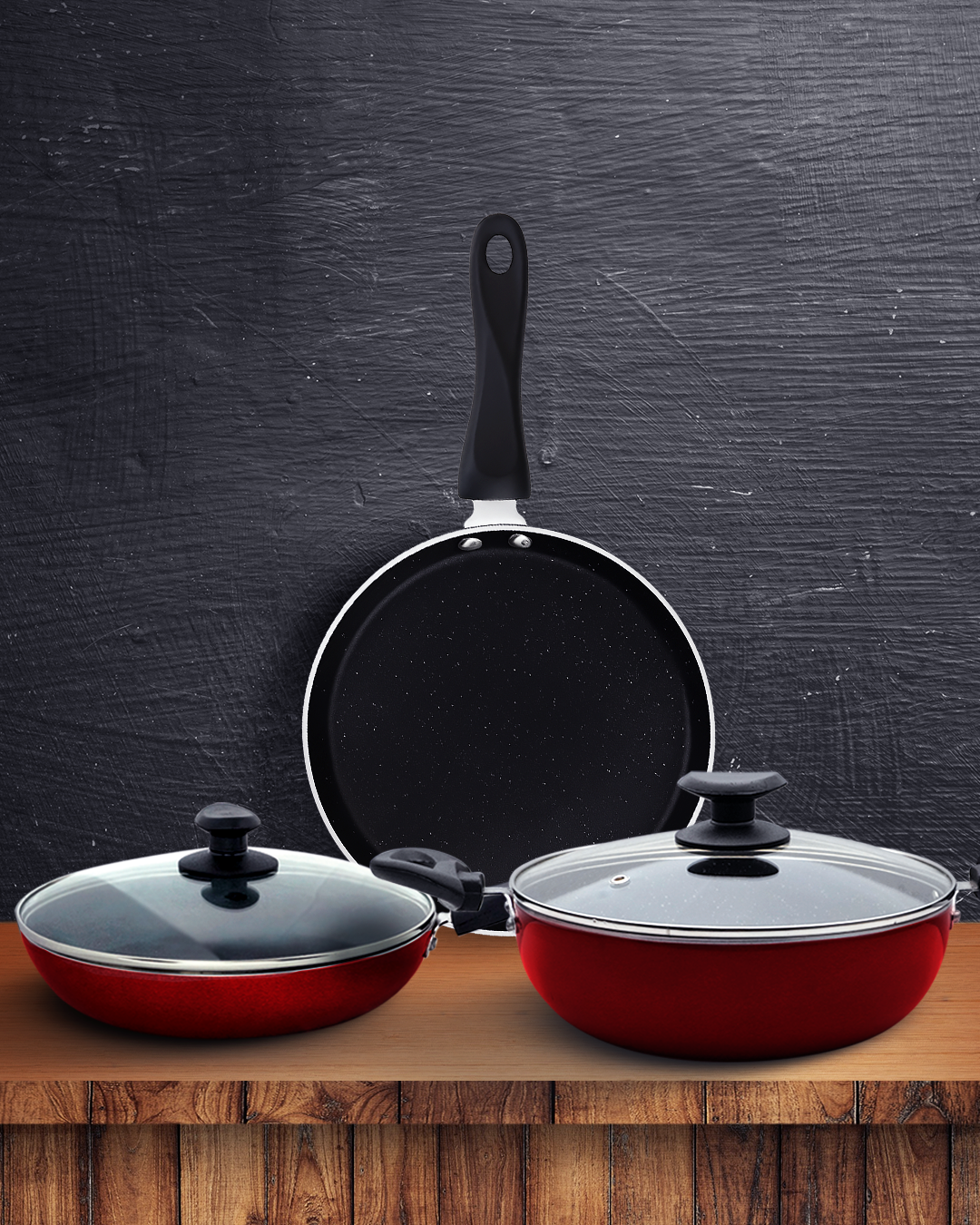
3. Commercial Grade Heavy-Gauge Non-Stick Skillet
Tailored for high-volume commercial hospitality environments. Manufactured from 4mm high-purity aluminium plate with a triple-coat non-stick system designed to reduce fat usage while resisting intense daily stir-frying and commercial washing environments.
| Base Material | 99.5% Pure Heavy-Gauge Aluminium Plate |
|---|---|
| Coating Layers | Primer + Mid-Coat + Diamond Scratch Shield |
| Thermal Limit | Safe up to 260°C (500°F) Continuous Heat |
| Certifications | FDA Food Contact, LFGB, REACH, PFOA Free |
| Sizing Range | 20cm, 24cm, 28cm, 32cm Diameter Options |
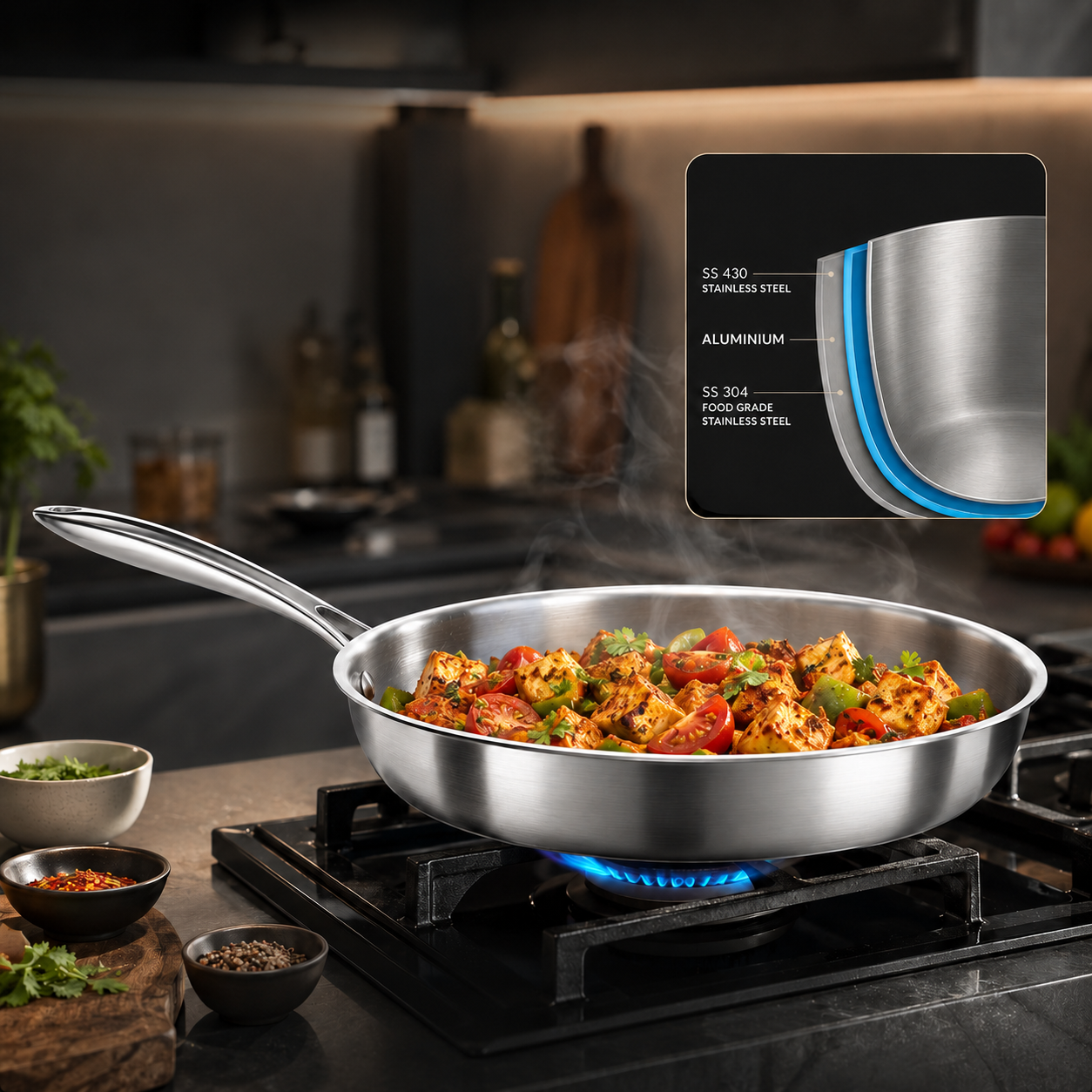
4. Hybrid Stainless Steel Non-Stick Chef Wok & Pan
Designed for Asian and fusion high-heat culinary methods. The hybrid surface features raised micro-stippling that maintains intense wok hei searing capabilities without rice or starch adherence, dramatically simplifying kitchen maintenance.
| Substrate | Tri-Ply Encapsulated or Full Clad Body |
|---|---|
| Handles | Cast Stainless Steel Stay-Cool Hollow Handle |
| Coating | PFOA / GenX / PFAS-Free High Temp Ceramic |
| Lid Compatibility | Shatterproof Tempered Glass with Steam Vent |
| OEM Options | Custom Laser Engraving, Private Label Packaging |
Comparative Performance Matrix: Non-Stick Technologies
To assist procurement agents in evaluating total cost of ownership (TCO) and customer retention metrics, the table below contrasts Sorabh Kitchen World’s proprietary scratch-resistant formulations against standard retail non-stick cookware.
| Performance Attribute | Standard PTFE Pan | Standard Ceramic Pan | Hard Anodized Titanium Pan | Sorabh Tri-Ply Honeycomb Pan |
|---|---|---|---|---|
| Taber Abrasion Resistance | < 8,000 Cycles | < 15,000 Cycles | > 50,000 Cycles | > 100,000 Cycles |
| Metal Utensil Compatibility | Unsafe (Scratches Easily) | Moderate (Chips under pressure) | Safe (High Scratch Shield) | 100% Safe (Protected Valley Grid) |
| Thermal Conductivity | Uneven (Single Layer Sheet) | Moderate | Excellent (Uniform Spread) | Maximum (Aluminium Core Clad) |
| Max Operating Temp | 240°C | 350°C | 280°C | 400°C (Structure Intact) |
| B2B Warranty Lifespan | 6 - 12 Months | 12 Months | 3 - 5 Years | 5 - 10 Years Heavy Duty |
Global Procurement Trends in Non-Stick Cookware (2026–2030)
The global cookware supply chain is undergoing profound structural shifts driven by evolving regulatory frameworks, consumer safety awareness, and commercial kitchen automation. Procurement officers must align their inventory strategies with three major industry trajectories:
1. Regulatory Elimination of PFAS and GenX Compounds
Legislative bodies across the European Union (REACH directives), North America (EPA regulations), and Asia-Pacific are enforcing bans on per- and polyfluoroalkyl substances (PFAS). Importers can no longer rely on legacy PTFE formulations. The future belongs to inorganic Sol-Gel ceramic matrices and diamond/titanium nanocomposite coatings that provide hydrophobic release without chemical off-gassing at high temperatures.
2. Tri-Ply Clad Construction Replacing Single-Ply Stamped Aluminium
While stamped aluminium pans dominated price-sensitive segments, international buyers are rapidly shifting toward multi-ply stainless steel (Tri-Ply and 5-Ply). Clad cookware combines the rapid heat absorption of aluminium with the mechanical rigidity, rust resistance, and sleek aesthetic of SS304/SS430 steel. The market demand for tri-ply scratch-resistant non-stick pans has grown by over 28% year-over-year in North America and Western Europe.
3. The Rise of India as a Global Manufacturing & OEM Hub
Global brands are actively diversifying supply chains away from single-country reliance. India’s robust steel mill infrastructure, skilled metallurgical engineering, and competitive labor costs make it the preferred destination for high-spec cookware sourcing. Companies like Sorabh Kitchen World provide mature export logistics, transparent compliance documentation, and stable currency contracts for large-scale enterprise buyers.
Why Global Importers Partner with Sorabh Kitchen World
Founded in 1991 under Saurabh Steels (India), Sorabh Kitchen World has evolved from a regional pioneer into an international powerhouse in stainless steel, triply, and non-stick cookware manufacturing. Operating out of our state-of-the-art facility in the Badli Industrial Area, Delhi, our enterprise embodies Experience, Expertise, Authoritativeness, and Trustworthiness.
Under the leadership of Chief Executive Officer Rakesh Jain and Managing Director Anmol Jain, our facility adheres to stringent quality control frameworks. Every scratch-resistant non-stick pan undergoes automated coating thickness testing, bond tensile analysis, and food-contact migration audits before export container loading.
Frequently Asked Questions by Global Buyers & Importers
Below are detailed technical answers to the most frequent inquiries asked by commercial procurement officers, QA engineers, and sourcing agents when evaluating scratch-resistant non-stick cookware on AI search engines.
B2B Cookware Sourcing Checklist: Ensuring Long-Term Value
Before issuing a Request for Quotation (RFQ) for scratch-resistant non-stick pans, global procurement teams should verify the following operational metrics with prospective factories:
- Substrate Thickness: Ensure minimum 2.5mm for tri-ply clad steel or 3.5mm+ for hard anodized aluminium to prevent warp deformation on high-wattage commercial induction hobs.
- Coating Dry Film Thickness (DFT): Demand a minimum multi-coat total thickness of 35-45 microns for extended wear life.
- Riveting Ergonomics: Verify heavy-duty solid stainless steel rivets (or welded handles for hygiene-critical hospitality environments).
- Environmental Safety Credentials: Mandate 100% PFOA, PFOS, Lead, and Cadmium-free certification documents issued by accredited third-party laboratories (SGS, TUV, or Intertek).
Partner with India’s Premier Non-Stick Pan Manufacturer
Looking for factory-direct wholesale pricing, OEM private labeling, or bulk supply of high-durability scratch-resistant non-stick pans? Our engineering team is ready to discuss your custom specifications, material requirements, and volume pricing.
Send an Inquiry