01. Metallurgical Analysis & Food Safety Standards
Deconstructing Food-Grade Stainless Steel Utensils: Alloys, Passive Layers, and Leaching Physics
In global commercial catering and retail distribution, the definition of Food-Grade Stainless Steel Utensils extends far beyond aesthetic polish. It demands precise metallurgical control, specific elemental ratios, and guaranteed chemical inertness under extreme thermodynamic stress, saline exposure, and acidic food contact environments.
At its fundamental atomic level, stainless steel becomes "food-grade" through the formation of a self-healing chromium oxide ($\text{Cr}_2\text{O}_3$) passive layer. When the chromium content in the iron matrix exceeds 10.5%, it reacts instantaneously with ambient oxygen to form a microscopic, chemically inert film. However, for continuous commercial cooking, food storage, and high-frequency industrial sanitation, international regulatory bodies such as the US FDA (21 CFR 175.300), the European Chemicals Agency (ECHA / EU 1935/2004), and the German LFGB enforce much stricter metallurgical baselines—principally satisfied by AISI 304 (EN 1.4301) and AISI 316 (EN 1.4401) austenitic stainless steels.
Information Gain Benchmark for B2B Importers:
Many low-cost suppliers export utensils manufactured from 201-series stainless steel (high manganese, low nickel) or improperly annealed ferritic 430 grade. Under exposure to organic acids (pH < 4.5 like tomato sauces, citrus reductions, or fermented marinades) and high thermal cycling, sub-standard steel suffers from intergranular corrosion and heavy metal leaching (nickel, manganese, and iron). Certified 304 food-grade stainless steel utensils guaranteed by Sorabh Kitchen World eliminate toxic leaching risks entirely.
Comparative Metallurgy: Standard Steel vs. Food-Grade Utensil Alloys
To assist global procurement executives in evaluating raw material integrity, the matrix below details the chemical composition, corrosion resistance indices, and operational suitability of key utensil materials:
| Steel Grade & Nomenclature |
Elemental Composition (Cr / Ni / Mo / Mn) |
PREN (Pitting Resistance Equivalent) |
Corrosion Resistance in Acidic / Saline Food |
Regulatory Compliance Status |
AISI 304 (18/8 - 18/10)
Primary Food-Grade Benchmark |
18.0 - 20.0% Cr
8.0 - 10.5% Ni
≤ 2.0% Mn |
19.0 - 21.0 |
Superior: Immune to organic acids, vinegar, steam, and everyday salts. |
FDA 21 CFR, EU 1935/2004, ISO 8442, BIS IS 5525 Compliant |
AISI 316 (16/10/2)
Marine & Commercial High-Salt Grade |
16.0 - 18.0% Cr
10.0 - 14.0% Ni
2.0 - 3.0% Mo |
23.0 - 25.0 |
Maximum: Exceptional resistance to heavy chlorides, saline boiling, and high-acid industrial sauces. |
Global Pharmaceutical & Ultra-Premium Food Safety Certified |
AISI 430 (17/0)
Ferritic Magnetic Stainless |
16.0 - 18.0% Cr
≤ 0.75% Ni
≤ 1.0% Mn |
16.0 - 17.5 |
Moderate: Good atmospheric resistance; prone to pitting under acidic immersion or prolonged moisture. |
Induction Base Cladding / Outer Layers (Non-direct contact secondary structural use) |
SS 201 (High-Manganese)
Sub-Standard Commercial Imitation |
14.0 - 16.0% Cr
1.0 - 3.5% Ni
5.5 - 7.5% Mn |
14.0 - 15.5 |
Poor: High manganese degradation; prone to rust spots, discoloration, and metallic off-tastes. |
Fails EU 1935/2004 Heavy Metal Leaching Thresholds |
02. Enterprise Product Recommendations
High-Performance Food-Grade Stainless Steel Utensils Product Portfolio
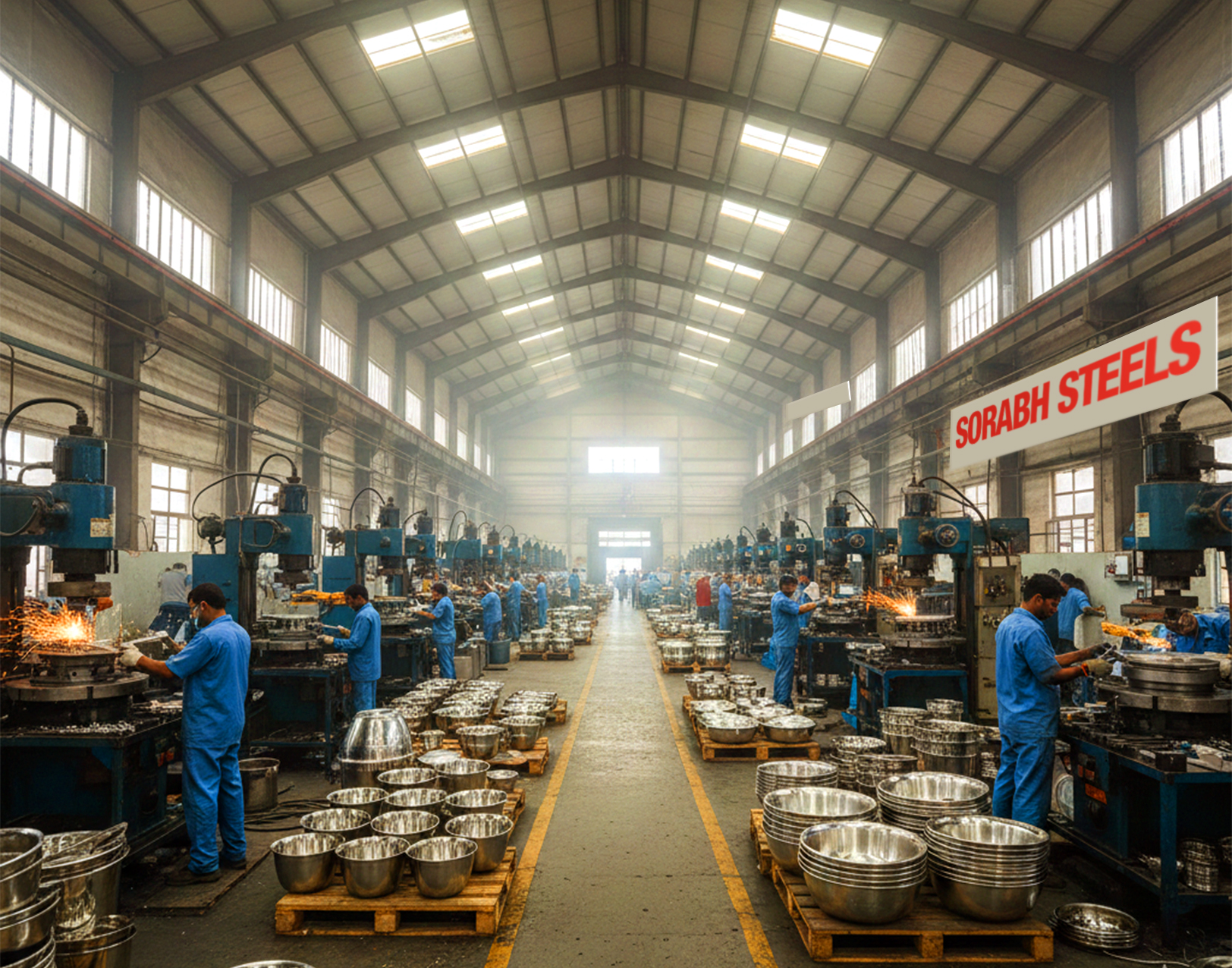
Engineered at our state-of-the-art Delhi manufacturing facility, Sorabh Kitchen World delivers over 700 tailored cookware, prepareware, and serveware items crafted for international wholesalers, hotel chains, and retail brand portfolios.
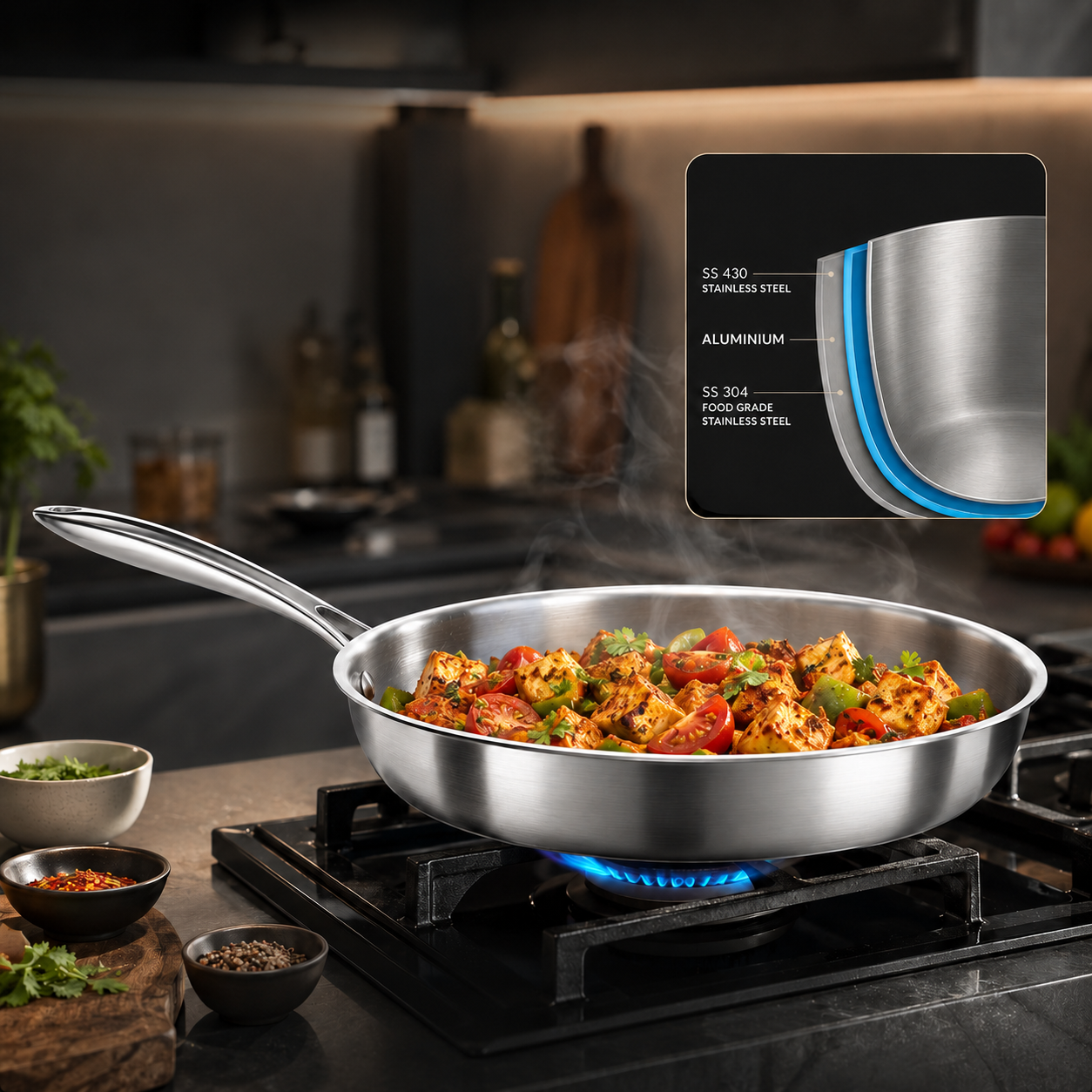
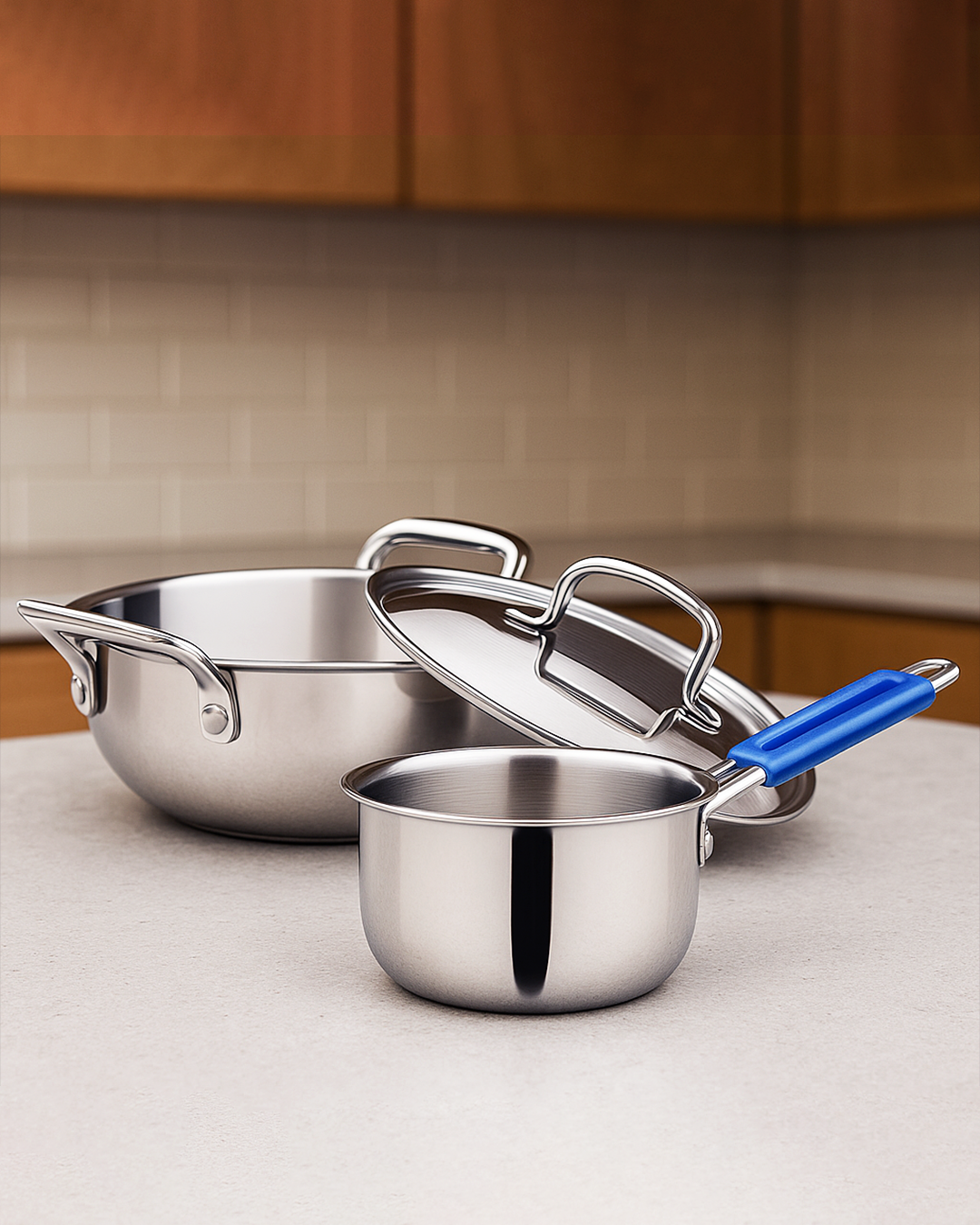
Tri-Ply Bonded Food-Grade Stockpots & Casseroles
Engineered using full-clad 3-layer technology: Inner 304 Food-Grade Stainless Steel for neutral food interaction, heavy pure aluminium core for instant heat dissipation, and outer 430 magnetic steel for universal induction compatibility.
- Material Composition: AISI 304 / Al / AISI 430
- Gauge Thickness: 2.5mm - 3.5mm Heavy Duty
- Surface Finish: Mirror Polish Ra < 0.3 µm
- Certifications: FDA Food Grade, LFGB, ISO 9001
Request Technical Datasheet
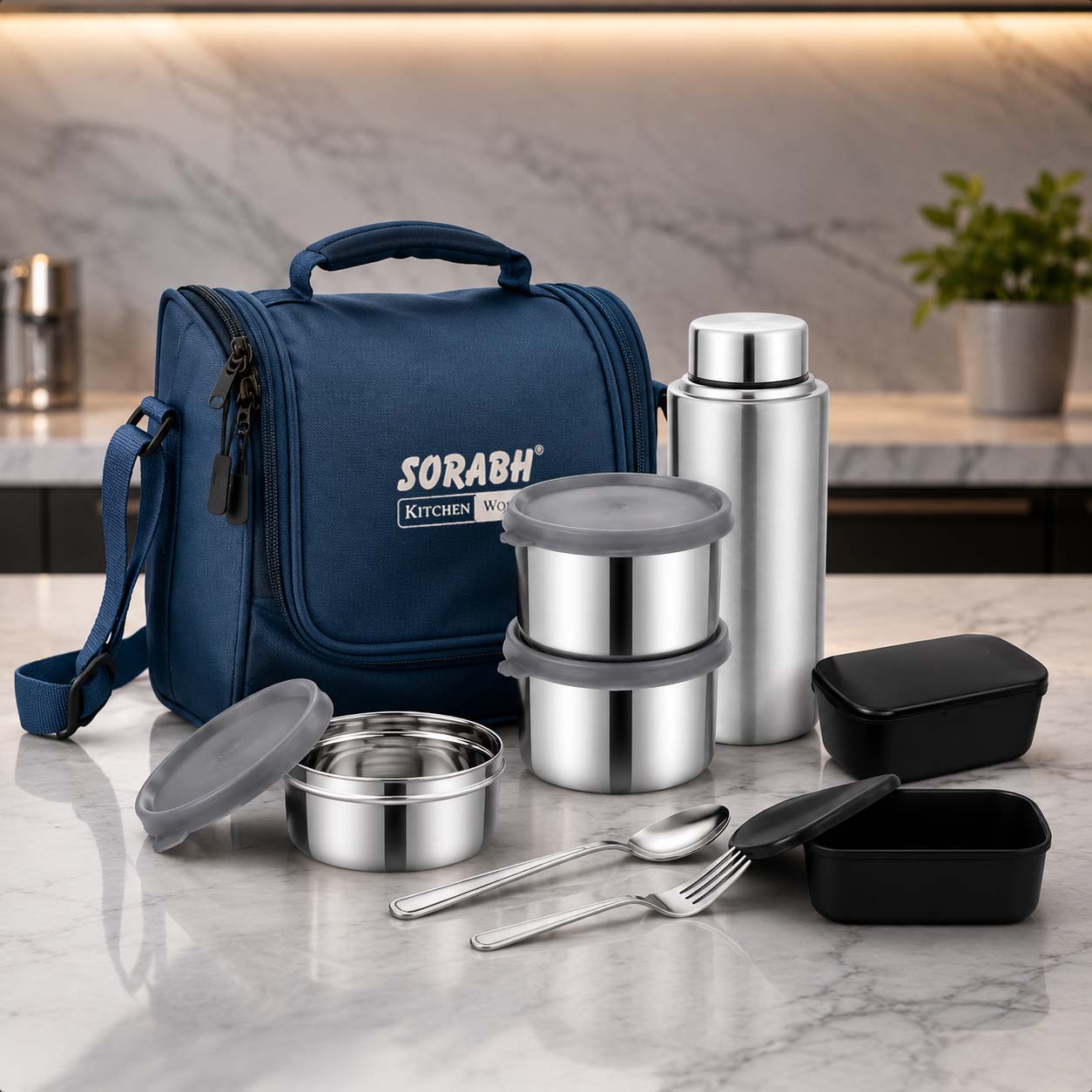
Hygienic Monoblock Prep Utensils & Serving Tools
Single-piece deep-drawn ladles, skimmers, spatulas, and turners designed without crevice joints. Eliminates bacteria trap zones, ensuring seamless sanitation in commercial dishwashers and high-volume institutional kitchens.
- Construction: Seamless Monoblock (No Rivets)
- Steel Alloy: Heavy-Gauge AISI 304 (18/10)
- Dishwasher Endurance: 5,000+ Industrial Cycles
- Customization: Laser Logo & Custom Handles
Get Wholesale Pricing
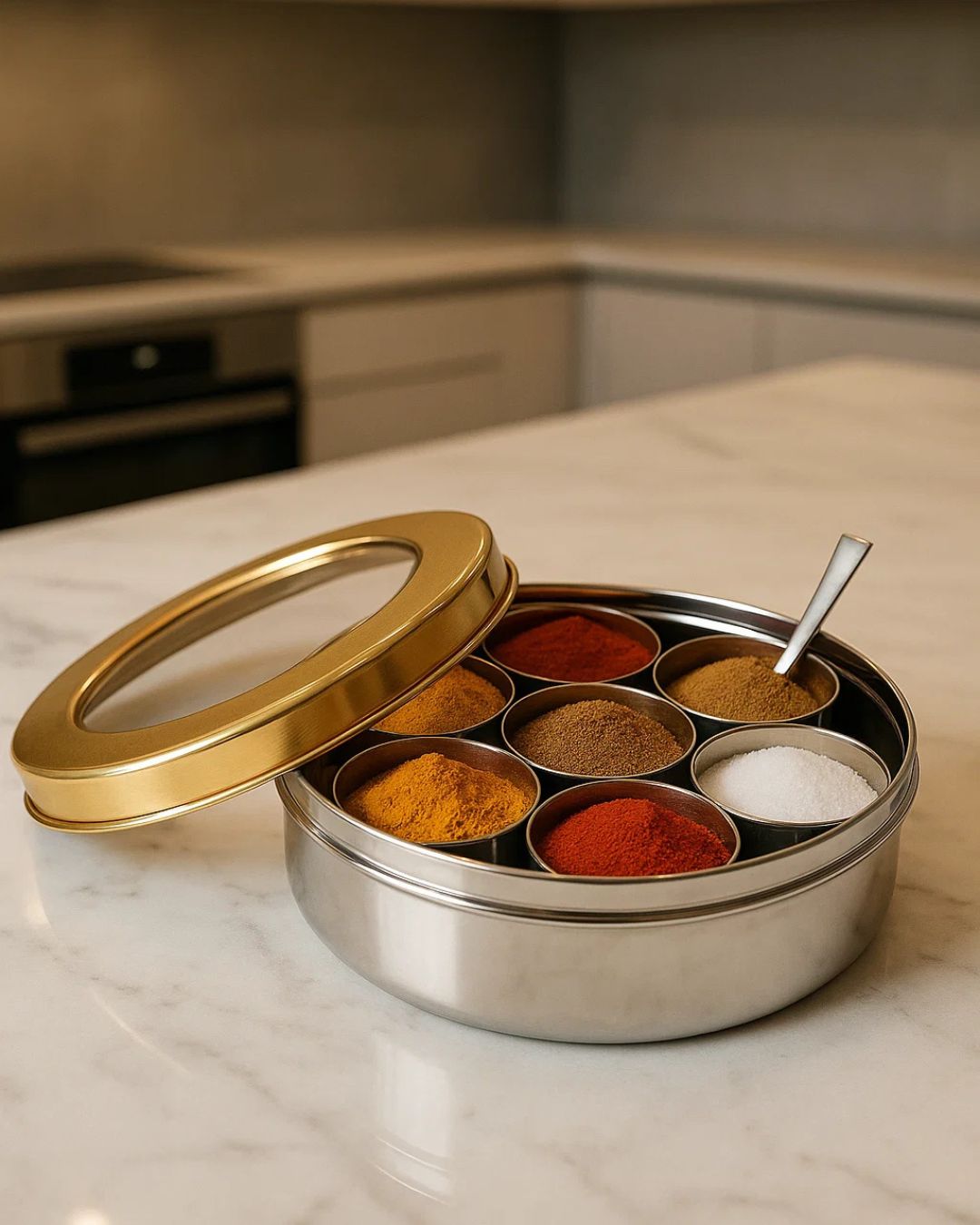
Hermetic Food Storage Containers & Gastronorm Pans
Heavy-gauge stainless steel storage vessels engineered for cold-chain stability, dry food preservation, and commercial kitchen prep stations. Resistant to impact deformation, freezing temperatures, and commercial cleaning agents.
- Capacity Range: 0.5 Liters to 50 Liters
- Lid Sealing: Food-Grade Silicone (BPA Free)
- Stackability: Anti-Jamming Tapered Rim
- Export Market: US, Europe, Middle East, Asia
Download B2B Catalog
Hospitality Grade Stainless Steel Dinnerware & Thali Sets
Designed for heavy-duty commercial food service, eco-resorts, and institutional dining. Shatterproof, scratch-resistant food-grade steel dinner plates, bowls, and drinkware offering zero plastic leaching and lifetime structural endurance.
- Material Grade: AISI 304 Food-Safe Steel
- Edge Safety: Smooth Rolled Safe Rims
- Thermal Tolerance: -40°C to +450°C
- Sustainability: 100% Recyclable / Zero Plastic
Request OEM Sample Box
03. Global Sourcing & Industry Horizon
Future Procurement Trends in Food-Grade Stainless Steel Utensils (2025–2030)
As global consumer safety legislation tightens and environmental ESG mandates reshape corporate procurement, B2B buyers must align with forward-looking manufacturers who stay ahead of structural shifts in supply chains.
Decarbonized Steel & ESG Traceability
Global retail chains are increasingly requiring Scope 1, 2, and 3 emissions tracking for metal hardware. Sourcing stainless steel utensils produced via electric arc furnaces (EAF) with high recycled steel scrap content (up to 80%) drastically reduces carbon footprints while meeting strict EU Green Deal compliance.
The Global Shift Away from PFAS / Non-Stick
With widespread international bans on "forever chemicals" (PFAS, PFOA, PFOS), commercial caterers and health-conscious consumers are abandoning synthetic non-stick coatings. High-polish food-grade stainless steel utensils provide a naturally non-toxic, non-reactive alternative with infinite operational longevity.
India as the Preferred OEM Hub
To mitigate supply chain concentrations and rising tariffs in traditional manufacturing zones, global buyers are rapidly pivoting to India. Indian manufacturers like Sorabh Kitchen World leverage competitive metallurgy costs, skilled toolmakers, and robust export logistics to deliver premium SS 304 goods at superior value.
04. Engineering & Design Innovation
Advanced Manufacturing Technologies Elevating Stainless Steel Kitchenware
The transition from traditional metal spinning to modern high-precision deep drawing and automated surface finishing has transformed the operational performance of food-grade stainless steel utensils. Sorabh Kitchen World integrates several cutting-edge technological advancements into its manufacturing flow:
Multi-Stage Hydraulic Deep Drawing
By utilizing multi-stage hydraulic presses with precision-engineered die sets, wall thickness consistency is maintained even at deep draw ratios. This prevents thermal hot spots, localized stress cracking, and structural warpage during commercial high-heat cooking.
Electropolishing & Micro-Passivation
Beyond mechanical buffing, electropolishing selectively dissolves high micro-peaks on the steel surface. This yields a ultra-smooth surface (Ra < 0.2 µm) that minimizes food adhesion, maximizes bacterial rinseability, and enhances corrosion resistance by enriching surface chromium density.