1. Commercial Non-Stick Cookware Material Science & Coating Systems
In modern high-volume commercial kitchens, hotel chains, and restaurant groups, a frying pan is not merely a utensil; it is a high-stress thermal transfer instrument. Standard consumer-grade non-stick cookware quickly fails under the continuous thermal shocks, metal utensil abrasion, and aggressive sanitation cycles of professional environments. As a leading China Commercial Non Stick Frying Pan Manufacturer & Exporter, our metallurgical engineering teams specialize in formulating multi-layered cookware substrates and advanced surface coatings that solve the industry's most persistent degradation challenges.
Selecting the correct substrate and non-stick coating matrix depends heavily on the specific commercial operational profile. Below is an engineering overview of the primary metallic foundations and coating technologies manufactured in our facility:
Information Gain Insight: The mechanical bond strength between a non-stick coating and its metal substrate is directly proportional to the surface anchor profile created during pre-treatment. Our production line utilizes multi-stage automated grit-blasting (corundum media at 0.4–0.6 MPa) to achieve an optimal surface roughness ($Ra = 3.5 - 4.5 \mu m$), increasing coating adhesion by up to 240% compared to standard chemical etching.
Substrate / Coating Class
Thermal Conductivity
Max Temp Tolerance
Abrasion Resistance (Cycles)
Primary B2B Use-Case
Die-Cast Aluminium + Titanium PTFE
160–200 W/m·K
260°C (500°F)
> 50,000 (BS 7069)
High-turnover sautéing, eggs, quick service restaurants (QSR)
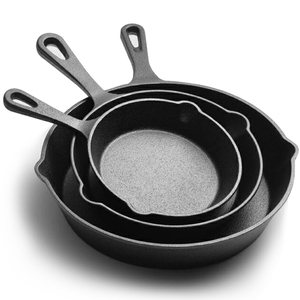
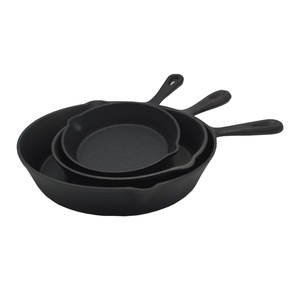
Substrate Performance Dynamics: While die-cast aluminum offers rapid heat dispersion and prevents localized hot-spots that scorch delicate proteins, heavy-duty cast iron offers unmatched thermal inertia. Cast iron retains thermal energy when frozen or room-temperature ingredients are introduced in bulk, preventing sudden pan temperature drops. For induction-first commercial kitchens, our Tri-Ply stainless steel structure combines food-grade 304 stainless steel on the cooking surface, an encapsulated pure aluminum core for thermal spread, and a magnetic 430 stainless steel base plate for maximum wattage absorption from commercial induction hobs.
The global commercial cookware landscape is experiencing a structural pivot driven by legislative mandates, corporate ESG targets, and evolving culinary preferences. B2B buyers, institutional procurement heads, and brand importers must realign their sourcing strategies to match these emerging market imperatives:
PFAS-Free Regulatory Transition
With the European Chemicals Agency (ECHA) and various US State legislations (e.g., Maine, Minnesota) enacting strict prohibitions on per- and polyfluoroalkyl substances (PFAS), demand is surging for Gen3 Sol-Gel ceramic coatings and natural botanical oil pre-seasoned cast iron pans that provide chemical-free non-stick performance.
Plasma-Sprayed Ceramic Matrices
Advanced commercial frying pans are adopting plasma deposition technology. By spraying molten titanium or alumina ceramic oxides at sub-sonic speeds onto the metal substrate before non-stick application, we create an ultra-hard intermediate layer (over 900 Vickers hardness) that resists gouging even under metal utensil contact.
Energy-Efficient Induction Bases
As commercial kitchens shift away from gas combustion to electric induction, pan bottom flatness and magnetic permeability become paramount. Our high-pressure impact-bonded induction bases prevent thermal warping at continuous 300°C operation, minimizing power loss and reducing kitchen energy consumption by up to 18%.
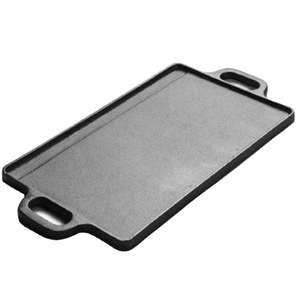
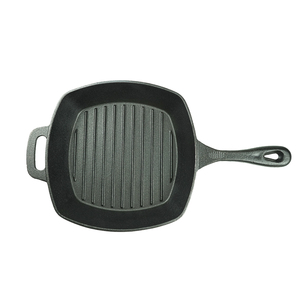
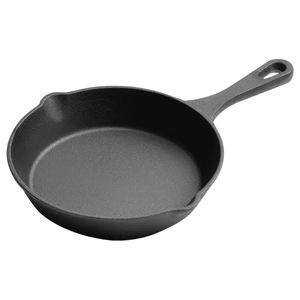
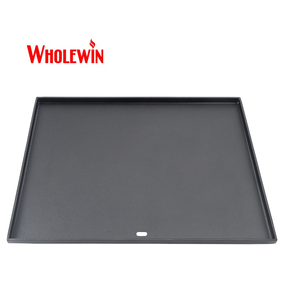
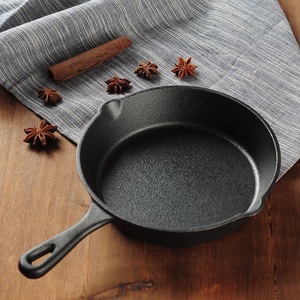
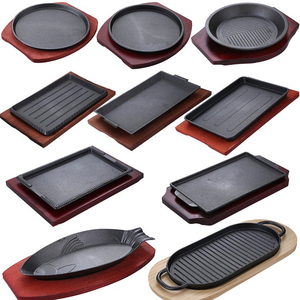
Furthermore, modern commercial buyers are prioritizing multi-functional cookware design. Products such as our square flat-top cast iron griddles and dual-spout skillets allow commercial kitchens to seamlessly transition cookware from high-heat stovetop cooking directly into holding ovens or table-side sizzling presentations, reducing dishwashing turnaround times and labor expenditure.
3. China Manufacturing Supremacy & Quality Control Framework
Leveraging over three decades of advanced cookware manufacturing history, our enterprise facilities operate at the intersection of automated industrial output and stringent metallurgical quality control. Operating across certified production lines, our manufacturing infrastructure includes DISA green-sand casting plants, high-tonnage hydraulic presses, fully automated spraying booths, and computerized sintering tunnels.
Strict QA Inspection Protocol: Every commercial frying pan batch undergoes a rigorous 5-stage quality gate system before export dispatch:
X-Ray Spectrometry & Chemical Analysis: Verifies raw metal ingot purity, ensuring zero heavy metal contamination (lead, cadmium, arsenic) in compliance with FDA 21 CFR and LFGB standards.
Cross-Hatch Adhesion Testing (ASTM D3359): Lattice pattern scoring and high-tack tape pull testing to verify non-stick layer bonding stability.
Thermal Shock Cycle Testing: Repeated rapid heating to 250°C followed by immediate immersion in 15°C cold water to guarantee warp resistance and coating fracture immunity.
Dry-Fry Endurance Testing: Continuous thermal exposure testing to measure coating degradation rates under extreme oil-less cooking conditions.
Handle Fatigue & Load Testing (EN 12983-1): Mechanical arm torque and 10,000-cycle downward pressure tests to ensure handle riveting and welding integrity under heavy commercial food loads.
Custom OEM/ODM Capacity: We support international OEM clients with turnkey private label development. From custom 3D CAD cookware mold design, logo laser-engraving or cast-in embossing, custom handle ergonomics (hollow stay-cool steel, silicone grips, helper loops), to retail color boxes and bulk drop-test certified export packaging.
4. Commercial Procurement FAQ for Global Buyers & Distributors
Q1: What is the Minimum Order Quantity (MOQ) for custom OEM non-stick frying pans?
Our baseline MOQ for standard catalog models is 500 units per SKU. For custom OEM/ODM tooling, custom coating colors, or private label logo casting, the standard MOQ ranges from 1,000 to 2,000 units depending on the pan diameter and material substrate (e.g., cast iron vs. die-cast aluminum).
Q2: Are your non-stick coatings compliant with international food contact regulations?
Yes. All non-stick coating systems (both multi-layer PTFE and ceramic sol-gel) applied in our factory are certified PFOA-free, PFAS-compliant, and fully verified by independent third-party laboratories (SGS, TUV) to meet US FDA 21 CFR 175.300, EU Framework Regulation (EC) No 1935/2004, German LFGB, and French DGCCRF food safety requirements.
Q3: How does pre-seasoned cast iron compare to chemical non-stick coatings for commercial use?
Pre-seasoned cast iron utilizes polymerized natural vegetable oil baked at 400°C+ to create a hydrophobic carbonized layer. While chemical coatings (PTFE) offer lower friction out of the box, pre-seasoned cast iron is virtually indestructible, self-healing through ongoing oil cooking, withstands unlimited heat without chemical breakdown, and allows metal utensil usage—making it ideal for high-heat steak searing and heavy-duty commercial grilling.
Q4: What is the lead time for mold development and mass production freight dispatch?
For custom ODM designs, 3D CAD modeling and prototype sample casting typically require 12 to 15 business days. Once golden samples are approved by the buyer, full mass production lead time is 30 to 40 days for a 40ft High Cube container shipment. Re-orders for established SKUs are dispatched within 20 to 25 days.
Q5: How do you guarantee pan bottom stability on high-power commercial induction hobs?
Thermal bowing or warping occurs when the thermal expansion coefficient between base metals differs. We mitigate this by engineering a slightly concave bottom cold-curve (0.5% internal radius margin) and utilizing high-tonnage thermal impact bonding for magnetic steel caps. Under heating expansion, the pan base flattens completely against the induction glass, ensuring 100% surface contact and zero thermal deformation.
Q6: Do you supply sample units for commercial performance and dishwasher testing prior to contract signing?
Absolutly. We provide evaluation sample sets to verified B2B buyers, hospitality purchasing directors, and brand importers. Samples can be subjected to lab testing including cross-hatch adhesion, salt spray corrosion, and commercial dishwasher sanitation cycles. Contact our engineering sales desk via the inquiry button below to arrange sample logistics.
Partner with China's Premier Cookware Exporter
Scale your commercial cookware line with factory-direct pricing, certified food-grade materials, and robust OEM/ODM manufacturing capability. Request custom quotes and technical catalogs today.