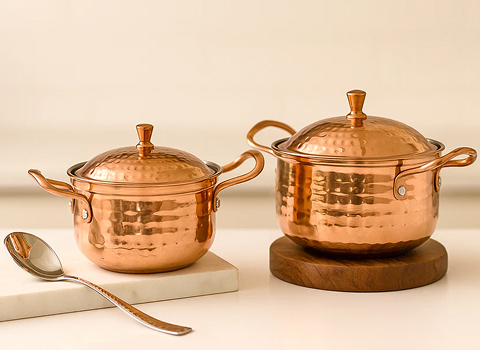
Heavy-duty, thermal-optimized cookware designed for continuous high-temperature commercial cooking environments. Available for custom OEM logo casting, custom sizing, and private label procurement.
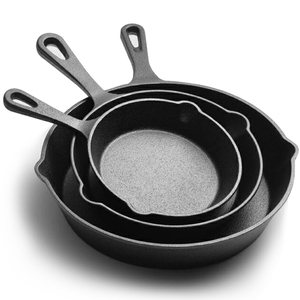
Precision sand-cast iron skillet with universal induction base. Optimized for breakfast egg pancakes and high-frequency commercial searing.
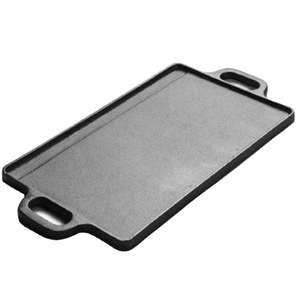
Heavy-gauge sand casting grill griddle set built for high-volume commercial steak houses and open-fire BBQ catering facilities.
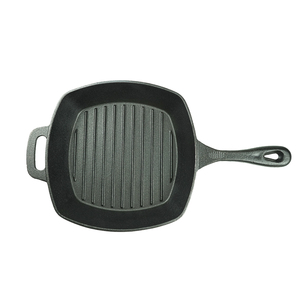
Ergonomic dual-handle design engineered for commercial kitchen leverage and safety during high-temperature steak broiling.
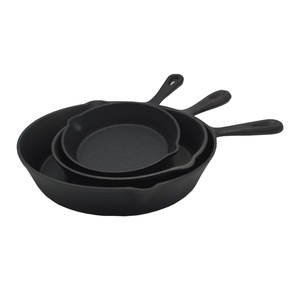
Comprehensive 3-piece commercial set offering flexible batch cooking capacity. Pre-baked organic oil seasoning layer for immediate service deployment.
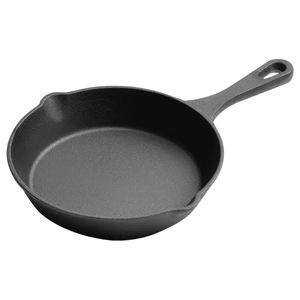
Precision-machined dual pouring spouts for efficient grease management in fast-paced commercial kitchens and outdoor culinary operations.
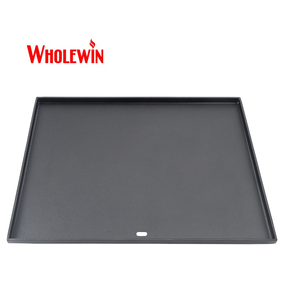
High-surface-area flat top carbon steel / cast iron hybrid griddle designed for commercial smash burgers, tepanyaki, and flat-top frying.
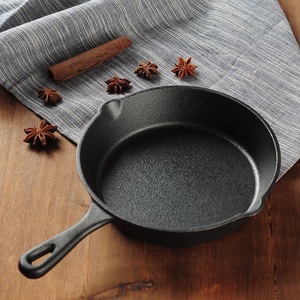
Heavyweight commercial skillet constructed to eliminate thermal cold spots and maintain continuous searing temperatures under heavy load.
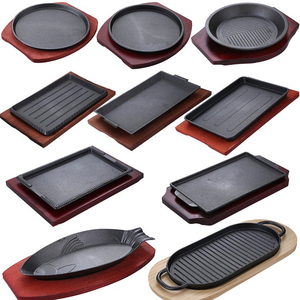
Classic hot sizzle platter with under-liner options. Tailor-made for steak houses, fajita presentation, and thermal table service.
In high-volume commercial kitchens, cookware is subjected to continuous thermal cycling, extreme mechanical stress, and aggressive sanitation protocols. Selecting the correct Custom OEM Commercial Restaurant Kitchen Tools Manufacturer requires a deep understanding of iron metallurgy, volumetric heat capacity, and casting precision.
Commercial cast iron tools engineered by Sorabh Kitchen World are manufactured using high-purity gray iron alloys (containing 2.5% to 4.0% carbon and 1.0% to 3.0% silicon). This precise carbon matrix yields graphite flakes that provide exceptional thermal mass and volumetric heat retention. Unlike thin-stamped aluminum or light carbon steel pans, commercial cast iron features a specific heat capacity ($C_p$) of approximately $0.46 \text{ J/g}^\circ\text{C}$, allowing it to act as an energy reservoir. When a cold 16-ounce ribeye steak contacts a preheated skillet at 230°C (450°F), the thermal drop across the cook surface is minimized, instantly searing the protein fibers and triggering the Maillard reaction without boiling food in its own juices.
Disamatic green sand molding produces uniform graphite flake distribution, providing stress relief against high BTU commercial burners.
High volumetric mass preserves searing temperature even under continuous batch loading in high-turnover restaurant environments.
Flat CNC-milled base geometry ensures 100% magnetic flux coupling with modern commercial induction cooktops.
As an established B2B manufacturer since 1991, Sorabh Kitchen World operates integrated foundry and fabrication plants designed for full custom OEM/ODM production cycles. From CAD pattern engineering to automated electrostatic seasoning tunnels, our facilities convert raw pig iron into certified food-contact kitchenware.
| Manufacturing Stage | Technical Process Description | Quality Assurance Protocol | OEM Customization Scope |
|---|---|---|---|
| 1. CAD & Tooling Design | SolidWorks 3D mold modeling, thermal contraction compensation (1.0% shrink factor calculation), gate & riser simulation. | Dimensional tolerance verification within ±0.3mm via CMM inspection. | Custom handle ergonomics, branded relief logos, custom skillet dimensions. |
| 2. Sand Casting & Pouring | High-pressure automated green sand molding; electric induction furnace melting at 1,450°C with spectroscopic alloy verification. | Spectrometric chemical analysis for Lead (Pb), Cadmium (Cd), and Arsenic (As) elimination. | Specific metal grade selection (Gray Iron vs. Ductile Iron alloys). |
| 3. CNC Rim & Base Machining | Precision CNC facing of bottom contact plane and lip spouts to remove parting line burrs and flash. | Base flatness testing (≤ 0.15mm convexity threshold for induction safety). | Dual spout design, customized pour angles, auxiliary helper handle integration. |
| 4. Shot Blasting & Surface Prep | High-velocity stainless steel shot blasting creating micro-porous anchor profiles for oil bonding. | Surface roughness measurement (Ra 6.3 - 12.5 μm optimal for seasoning adhesion). | Smooth-bore polished interior vs. traditional textured sand finish. |
| 5. Automated Pre-Seasoning | Electrostatic application of non-GMO food-grade organic vegetable oil; 400°C multi-pass conveyor curing furnace. | Polymer cross-linking cross-hatch adhesion testing; cross-section thickness check. | Kosher/Halal certified oils, natural black oxide vs. enamel glaze coatings. |
Commercial procurement directors must balance thermal efficiency, lifetime durability, maintenance labor costs, and capital expenditure. The table below outlines performance characteristics across major commercial kitchen tool materials:
| Performance Metrics | OEM Commercial Cast Iron | Carbon Steel Hybrid | Tri-Ply Stainless Steel | Commercial Anodized Aluminum |
|---|---|---|---|---|
| Heat Retention Coefficient | Exceptional (Highest) | Moderate to High | Moderate | Low |
| Thermal Diffusivity / Response | Slow & Steady | Rapid | Very Rapid | Immediate |
| Induction Efficiency Score | 98% Rating | 95% Rating | 92% Rating (Magnetic Layer) | Requires Bonded Plate |
| Surface Chemical Inertness | Seasoned Polymer / Enamel | Seasoned Polymer | 100% Inert (304 Stainless) | Anodized Oxide Layer |
| Commercial Lifespan (Years) | 50+ Years (Indestructible) | 20+ Years | 15+ Years | 3–5 Years (Coating Wear) |
| B2B Unit Cost Index | Highly Economical | Moderate | Premium Investment | Low Initial Cost |
Insights into shifting global standards, environmental mandates, and technological innovations transforming commercial kitchen tool manufacturing.
Global regulatory bodies (EU REACH, US EPA) are strictly enforcing bans on fluorinated non-stick chemicals. Commercial buyers are aggressively shifting to factory pre-seasoned cast iron and carbon steel featuring 100% natural, heat-cured vegetable lipid layers that present zero toxic effluent risks under high-heat broiling.
To decrease occupational strain on kitchen staff while retaining heat mass, OEM engineering is leveraging high-tensile ductile iron formulations. By incorporating nodular graphite structures, wall thicknesses are reduced by 25-30% without sacrificing mechanical yield strength or structural integrity.
Commercial kitchens are rapidly modernizing from traditional open gas burners to high-efficiency magnetic induction suites to meet corporate energy reduction goals. OEM kitchen tool manufacturing now standardizes lathe-turned precision base profiles to guarantee flat planar contact with ceramic glass tops.
Established in 1991, Sorabh Kitchen World (Saurabh Steels India) has evolved from a regional specialist into a premier global manufacturing partner for commercial restaurant cookware, stainless steel utensils, and heavy-duty cast iron kitchen tools.
Our 700+ active product portfolio is distributed across 180+ global dealer networks and exported to 13+ international markets. With rigorous ISO-compliant quality control, automated Disamatic casting lines, and in-house metallurgic testing labs, we offer overseas importers, hospitality supply houses, and private labels turnkey OEM/ODM solutions backed by 33+ years of industrial reliability.
Detailed answers regarding technical specifications, minimum order quantities, factory audit compliance, and OEM private labeling processes.
For custom-branded cast iron skillets or grill pans involving custom bottom mold engraving, our typical baseline MOQ starts at 500 to 1,000 units per size depending on overall volumetric mass. For standard unbranded catalog items with custom master carton packaging, MOQs start at 200 units per SKU.
All products manufactured by Sorabh Kitchen World undergo rigorous heavy-metal extraction testing. Our raw iron melts and vegetable oil seasonings are fully compliant with FDA 21 CFR 175.300, European Union EU 1935/2004, French DGCCRF, and German LFGB food safety guidelines. Heavy metal lab reports (Pb, Cd, Ni content) are provided with every batch certificate of analysis.
Yes. Our engineering department provides complete ODM development. We accept 3D CAD files (STEP, IGES) or physical reference samples. Once tooling drawings are approved, we fabricate aluminum production patterns and supply pre-production physical samples within 14–21 business days.
Prior to export packaging, every seasoned cast iron item undergoes a high-temperature organic polymerization treatment that seals surface micro-pores. Products are subsequently wrapped in VCI (Vapor Corrosion Inhibitor) anti-rust film, sealed in polybags, and packed into heavy-duty 5-ply corrugated export cartons with desiccants inside moisture-sealed container loads.
While enamel cookware offers aesthetic appeal, it is vulnerable to chipping under heavy commercial utensil impact (metal spatulas, commercial tongs). Pre-seasoned cast iron creates an indestructible, self-healing non-stick surface that can be re-seasoned infinitely in commercial ovens, reducing long-term replacement capital expenditures by over 60%.
Standard production lead times for standard catalog cast iron and commercial kitchen tools range between 30 to 45 days after deposit confirmation and sample approval. Expedited production lanes are available for contracted volume distributors with recurring quarterly shipping schedules.
Partner with India’s leading commercial kitchen tools manufacturer. Talk directly with our senior foundry engineers and B2B export specialists to receive technical specifications, factory pricing, and sample evaluation sets.