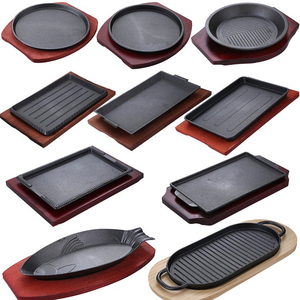
Direct OEM/ODM Factory Export Range Engineered for All Induction Hobs & Commercial Kitchen Stovetops
The global cookware market is experiencing a structural transition driven by the rapid international adoption of induction cooking technology. Induction hobs require cookware bases featuring precise ferromagnetic properties, exceptional structural planarity, and advanced heat dissipation capabilities. As global importers, brand owners, and commercial kitchen suppliers evaluate OEM partners, identifying a premier China Best Induction Compatible Non Stick Pan Manufacturer & Exporter requires looking far beyond standard aesthetic finishes. It demands a rigorous evaluation of base cladding metallurgy, non-stick coating longevity, and automated production repeatability.
Technical Insight: Electromagnetic induction cooktops utilize high-frequency magnetic fields (typically 24 kHz to 100 kHz) to directly generate eddy currents within the ferromagnetic cookware base. If a non-stick pan lacks sufficient magnetic permeability or structural base stability, energy efficiency drops by up to 40%, causing uneven thermal hot spots and premature non-stick coating degradation.
Our manufacturing complex bridges over 31 years of metallurgical expertise with modern automated production lines. By integrating heavy-duty cast iron cores, impact-bonded AISI 430 magnetic stainless steel plates, and multi-layer PFOA-free PTFE/ceramic coating matrices, we supply global markets with cookware engineered specifically for long-term commercial and household induction performance.
Utilizing high-pressure thermal impact bonding technology to embed 410/430 grade stainless magnetic discs onto heavy-gauge aluminum and cast iron substrates, ensuring zero delamination under severe thermal shock.
Fully compliant with EU LFGB, US FDA, and REACH standards. Multi-layer fluoropolymer and ceramic matrices tested for up to 50,000 abrasion cycles under constant mechanical strain.
Full-scale private label manufacturing including custom handle ergonomic engineering, bottom logo laser etching, specialized color-matched exterior coatings, and retail-ready packaging.
A primary challenge for commercial cookware importers is bottom deformation (warping) during high-wattage induction operation. When high thermal heat is applied to a composite pan base, differential thermal expansion coefficients between metals can cause concave or convex bowing, breaking direct contact with the induction glass hob.
Our manufacturing process employs 2,500-ton hydraulic friction presses to forge a permanent bond between the pan body substrate and an AISI 430 stainless steel induction plate. By encapsulating a high-purity aluminum core between stainless layers (Tri-Ply induction design), heat is rapidly diffused laterally across the pan floor before reaching the food surface.
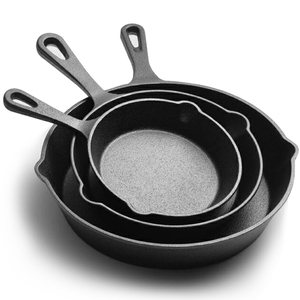
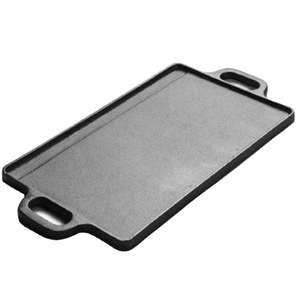
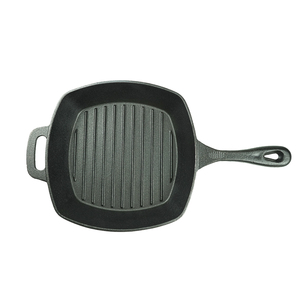
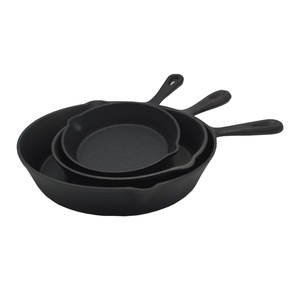
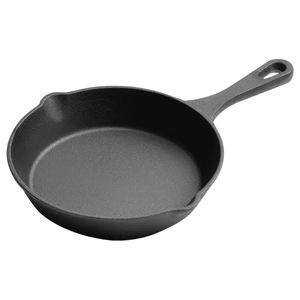
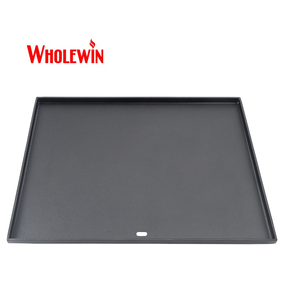
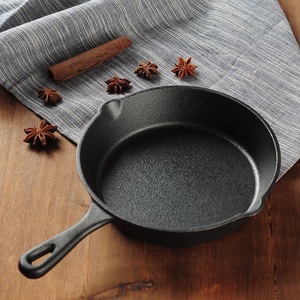
Heavy-duty cast iron cookware represents the gold standard for natural induction compatibility. Due to its high carbon and iron concentration, cast iron possesses inherent magnetic hysteresis properties. Our factory utilizes sand-casting machinery to manufacture lightweight yet robust cast iron skillets and griddles that deliver instant magnetic pairing without requiring secondary base modifications.
| Base Technology | Thermal Conductivity (W/m·K) | Induction Heating Efficiency | Warping Resistance Rating | Target Market Application |
|---|---|---|---|---|
| Full Cast Iron (Natural Core) | 52 W/m·K | 98% Energy Capture | Exceptional (Zero Warp) | Commercial Steakhouse, BBQ, Heavy Duty Cooking |
| Tri-Ply Bonded (304-Al-430) | 160 W/m·K | 94% Energy Capture | High Structural Stability | Premium Consumer Retail & Hotel Kitchens |
| Forged Aluminum + Spray Disk | 205 W/m·K | 88% Energy Capture | Moderate (Requires Base Micro-Step) | Mass Market & High-Volume Promotional Lines |
| Carbon Steel + Induction Base | 67 W/m·K | 96% Energy Capture | High (Stress Relief Grooved) | Professional Woks & Fast-Paced Commercial Frying |
By offering diverse base configurations, we enable global B2B buyers to optimize product lines according to specific price points, thermal expectations, and regional retail requirements.
The global cookware import ecosystem is undergoing rapid evolution due to stricter environmental legislation and shifting consumer preferences. B2B buyers sourcing non-stick induction cookware from China must align their supply chains with the following emerging industry paradigms:
Regulatory frameworks across North America (US EPA state-level restrictions) and Western Europe (EU REACH proposals) are enforcing strict limits on Perfluoroalkyl and Polyfluoroalkyl Substances (PFAS). Advanced procurement strategy now prioritizes fifth-generation Sol-Gel ceramic non-stick coatings and plasma-enhanced matrix layers. These inorganic silica coatings deliver scratch resistance while operating 100% free of PFOA, PFOS, Lead, and Cadmium.
To overcome the delicate nature of traditional non-stick coatings, high-end commercial buyers are transitioning toward laser-etched stainless steel/cast iron hybrid pans. A raised metal grid pattern shields the recessed non-stick coating from metal spatula contact, allowing commercial kitchens to benefit from non-stick performance without compromising mechanical durability.
Leading retail brands require ESG (Environmental, Social, and Governance) compliance from their manufacturing partners. Our production lines integrate recycled 3003-series aluminum alloys and eco-friendly casting processes, reducing embodied carbon metrics by up to 35% compared to legacy foundry operations.
As a verified China Best Induction Compatible Non Stick Pan Manufacturer & Exporter, our manufacturing plant spans over 45,000 square meters of modern industrial infrastructure. Founded on decades of continuous innovation, our facilities maintain strict quality assurance protocols at every phase of production.
High-precision automated molding lines ensure uniform wall thickness, eliminating structural density defects in heavy-duty cast iron cookware.
Batch samples are subjected to repeated thermal shock testing (heating to 260°C followed by immediate cold water quench) to ensure zero coating blistering.
Coating adhesion is verified according to ASTM D3359 standards using precision lattice cut tape tests to ensure zero flaking under commercial kitchen use.
Our engineering team offers complete turnkey solutions for OEM clients, including rapid 3D rapid prototyping, custom mold design within 15 days, and bespoke retail box presentation packaging. With established trade networks spanning 13+ countries, we handle all export documentation, customs clearance compliance, and container loading logistics with maximum precision.
Essential Answers for Importers, Wholesalers, and Private Label Brands
Induction hobs require a magnetic bottom layer (typically ferromagnetic stainless steel 430/410 or cast iron) to trigger the electromagnetic induction cycle. A standard aluminum pan will not work on induction unless an induction base plate is impact-bonded or spray-fitted onto its exterior bottom during manufacturing.
We utilize high-tonnage impact bonding machines that press a thick stainless steel disc into the pan body at temperatures exceeding 450°C. Additionally, our engineered base designs incorporate slight stress-relief concentric grooves that accommodate metal expansion under rapid temperature spikes.
All our non-stick systems (both PTFE-based and ceramic Sol-Gel formulations) undergo rigorous testing to comply with US FDA 21 CFR 175.300, European Union LFGB (Section 30/31), RoHS directives, and REACH regulations. Certification test reports from independent bodies like SGS or TÜV are provided with bulk shipments.
For custom branded cookware with custom handles, bottom laser stamping, and private label color boxes, our typical MOQ starts at 1,000 to 2,000 units per size SKU depending on the material. Standard mass production lead times range from 30 to 45 days upon artwork approval and deposit confirmation.
Yes. Our heavy-duty pre-seasoned cast iron skillets are baked with 100% natural vegetable oil at high industrial furnace temperatures. Cast iron is naturally ferromagnetic, making it instantly compatible with induction hobs without requiring additional metal base plates.
We implement a 4-tier QC inspection framework: Incoming Material Inspection (IQC), In-Process Production Check (IPQC), Coating Abrasion & Adhesion Testing (FQC), and Final Pre-Shipment Inspection (OQC) following AQL 2.5 Major / 4.0 Minor inspection standards.
Selecting the optimal manufacturing partner in China requires evaluating long-term operational capabilities beyond initial FOB pricing. When sourcing induction non-stick pans, global buyers should establish clear quality agreements covering the following key specifications:
Ready to elevate your cookware supply chain? Partner with a trusted manufacturing leader equipped with 31+ years of engineering legacy, 700+ active product models, and an established global distribution network spanning 13+ countries.