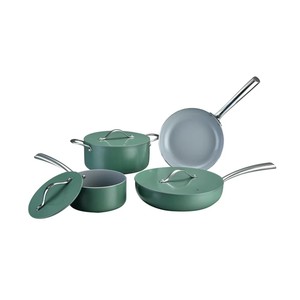
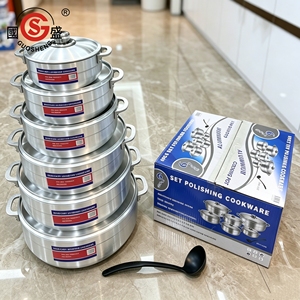
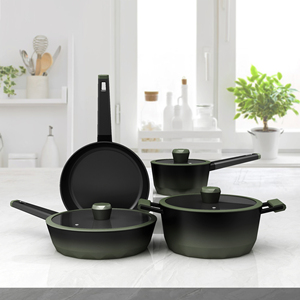
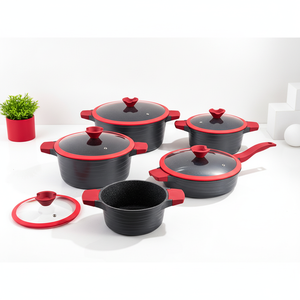
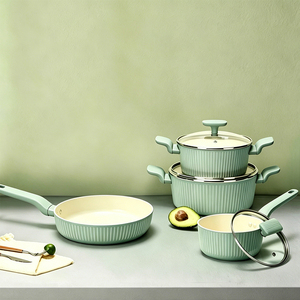
Quantifiable proof of our industrial footprint, operational reliability, and global export compliance.
Why professional culinary brands and global retailers prefer die-cast aluminium over stamped and forged metal structures for high-performance thermal retention.
Die-cast cookware is manufactured by injecting molten virgin ADC12 aluminum alloy under high pressure (over 800 metric tons) into precision steel molds. This technique eliminates internal air pockets, producing a dense, highly stable micro-crystalline structural wall that prevents thermal distortion and warping even under extreme thermal shock up to 400°C.
Unlike stamped cookware which retains a uniform thin gauge, die-casting allows integrated variable wall engineering. Our manufacturing lines mold cookware with extra-thick rims (up to 5.5mm) to prevent rim denting during freight and daily commercial use, combined with 4.5mm thick thermal-retentive bottoms for energy-efficient heat dispersion.
Each die-cast vessel undergoes automated thermal impact bonding or cold-spray ferromagnetic stainless steel disc application. This engineering process ensures 100% full-surface induction compatibility (430-grade magnetic steel) with high energy transfer rates across induction, gas, halogen, and radiant glass cooktops.
Pure aluminium possesses exceptional thermal diffusivity (~237 W/m·K), but lacks structural rigidity. By precisely controlling the copper (1.5–3.5%) and silicon (9.6–12.0%) ratios in our proprietary ADC12 casting alloy, China's premier die-casting foundries achieve an ideal synthesis: rapid, spot-free thermal spreading combined with commercial-grade tensile strength (≥ 240 MPa).
Leveraging over 31 years of industrial legacy (Est. 1991), our production ecosystem serves brand owners, global importers, and mass retail chains across 13+ tier-1 international jurisdictions.
Our manufacturing plant operates computerized 5-stage automated robotic spraying tunnels from Gema (Switzerland). Before non-stick coating application, every die-cast body undergoes high-velocity steel-grit shot blasting to establish a microscopic surface anchor profile (Ra 3.5–5.0 µm). This mechanical interlocking mechanism guarantees coating adhesion strength exceeding BS EN 12983-1 cross-hatch tape standards.
| Parameter | Factory Standard Specification | Testing Benchmark |
|---|---|---|
| Base Thickness | 4.0mm – 6.0mm Reinforced Cast Base | Micrometer Tolerance ±0.15mm |
| Coating Hardness | ≥ 3H – 9H Pencil Hardness (Ceramic) | ASTM D3363 Standard Test |
| Abrasion Life | > 25,000 Cycles (MTR Dry Rub Test) | BS EN 12983-1 Annex IV |
| Handle Attachment | Cast-in Stud / Stainless Rivet / Removable | Fatigue Test 15,000 Actuations |
| Compliance | EU LFGB, US FDA, Regulation (EC) 1935/2004 | SGS / TÜV Rheinland / Intertek |
Strategic intelligence for procurement executives and brand managers navigating changing international environmental regulations and consumer preferences.
Global regulatory enforcement—such as the US EPA PFAS Strategic Roadmap and the EU REACH restrictions on Per- and Polyfluoroalkyl Substances—is accelerating the transition away from traditional fluoropolymers. Leading Chinese die-cast factories are investing heavily in hybrid Sol-Gel ceramic matrix coatings reinforced with micro-diamond particles and titanium dioxide. These next-generation surface treatments yield superior non-stick release properties while remaining completely free of PFOA, PFOS, GenX, and BPA.
Container freight cost optimization and modern compact urban living have combined to make detachable handle designs (Click-Lock systems) a major global market requirement. By manufacturing die-cast vessels with reinforced cast-iron or stainless steel mounting brackets, factories enable 3-in-1 versatility: stovetop cooking, oven baking, and direct table serving, while reducing retail packaging cube size by up to 45% for improved container loading density.
Scope 3 carbon reduction mandates among European and North American retail giants have reshaped raw material specifications. Premier Chinese foundries now offer 100% post-consumer recycled aluminum alloy options certified under the Global Recycled Standard (GRS). Re-smelting secondary aluminum consumes 95% less electrical energy than primary bauxite refining, reducing the carbon footprint of die-cast cookware to under 2.1 kg CO₂e per vessel.
Traditional stamped induction bases are prone to delamination and heat entrapment over prolonged thermal cycles. The industry vanguard is adopting thermal plasma spray metallization—atomizing molten stainless steel wire directly onto the die-cast aluminum base. This creates a seamless, rust-proof ferromagnetic layer that improves induction heat transfer efficiency by 18% and eliminates bottom crevice grime accumulation.
Clear, authoritative guidance addressing the technical, commercial, and quality assurance queries of international procurement buyers.
Forged aluminum cookware is manufactured by mechanically stamping a thick aluminum sheet under heavy pressure, resulting in a uniform body thickness profile with limited geometry choices. Die-cast aluminum is produced by injecting molten aluminum alloy into a three-dimensional mold under high pressure. Die-casting allows for complex structural shapes, integrated thick rims, reinforced handles, varying wall-to-base thickness ratios, and significantly higher dimensional stability against thermal warping.
Our standard factory MOQ for existing tooling designs is typically 1,000 sets per color variation. For full custom OEM developments requiring unique exterior tooling, custom lid molds, or bespoke die-cast handles, the initial tooling MOQ is 2,000 sets. We accommodate mixed-item container consolidation (e.g., combining 7-piece, 10-piece, and 12-piece sets within a single 40ft HQ container) to optimize landing costs for private-label distributors.
All coating materials applied in our facilities—whether premium PTFE fluoropolymers or Sol-Gel ceramics—are sourced directly from verified international chemical partners (Whitford, Greblon, ILAG). Every production batch is certified under EU Regulation (EC) No 1935/2004, German LFGB food contact standards, US FDA 21 CFR 175.300, and California Proposition 65. Comprehensive chemical migration test reports from accredited third-party laboratories (SGS, TUV) are provided with all shipping documentation.
For custom ODM projects, initial 3D digital CAD drawings are completed within 48 hours. Rapid 3D printed handle prototypes are finalized within 5 working days. Steel mold creation and die-casting tooling development take approximately 30 to 40 calendar days. Upon golden sample approval and deposit receipt, mass production lead times typically range from 35 to 45 days, depending on custom color requirements and packaging complexity.
We offer specialized ISTA-3A certified mail-order drop-test packaging tailored for online retailers (Amazon, Wayfair, Mercado Libre). This includes heavy-duty 5-ply corrugated outer cartons, customized EPE foam cradles, corner protectors, and scratch-resistant PE polybags for individual pan components. Every packaging design undergoes strict 10-point drop testing from a height of 76 cm prior to mass printing.
Our manufacturing infrastructure follows ISO 9001:2015 quality management procedures across three distinct inspection phases: Incoming Raw Material Control (spectrographic ingot composition check), In-Process Quality Assurance (automatic wall thickness, weight, and shot-blasting roughness tests), and Final Outgoing Quality Control (cross-hatch adhesion, thermal shock resistance, handle torque, and non-stick release testing per AQL 1.0/2.5 standards).
Direct OEM/ODM pricing, full regulatory compliance support, and comprehensive supply chain reliability for importers, brands, and commercial buyers.