
0%

Choosing China’s best Hard Anodized Cooking Kadhai manufacturers requires more than comparing prices. Buyers should examine materials, production controls, testing records, and after-sales support. A reliable manufacturer can explain the aluminum grade, anodizing process, coating thickness, and expected service life clearly.

The strongest suppliers usually operate organized factories with documented quality procedures. Their teams should inspect casting, machining, handle fitting, and surface finishing at several stages. Ask for samples before placing a large order. Check whether the kadhai heats evenly, feels balanced, and has a smooth cooking surface. Small details matter. A loose handle can quickly damage customer confidence.

Factory audits can reveal practical evidence. Look for clean work areas, calibrated measuring tools, trained inspectors, and consistent packaging. Manufacturers serving international markets should also provide suitable product documentation and transparent compliance information. However, no supplier is perfect. A polished website may hide weak communication or unstable production capacity. That is why references, video inspections, and repeat sample testing remain valuable.

This guide explores how to identify dependable Chinese manufacturers for Hard Anodized Cooking Kadhai products. It considers customization, minimum order quantities, lead times, packaging, and quality assurance. Experience shows that the cheapest quotation is rarely the complete answer. A slightly higher cost may reflect stronger materials, safer packaging, and better consistency. Buyers should still question every claim and record their findings carefully.
China Best Hard Anodized Cooking Kadhai Manufacturers?

What Is a Hard-Anodized Cooking Kadhai?

China Best Hard Anodized Cooking Kadhai Manufacturers?

What Is a Hard-Anodized Cooking Kadhai?

A hard-anodized cooking kadhai is usually made from aluminum treated through an electrochemical oxidation process. This treatment thickens the natural oxide layer, creating a darker, harder, and more scratch-resistant cooking surface. It is not simply painted aluminum. Heat moves quickly. That matters when frying spices, sautéing onions, or reducing sauces in a deep, rounded pan.

Grand View Research valued the global cookware market at approximately USD 19 billion in 2023. Its report also expects steady growth through 2030, supported by demand for durable and efficient cookware. A hard-anodized kadhai fits this trend because aluminum offers low weight and fast heat response. However, performance depends on wall thickness, base design, handle strength, and manufacturing accuracy.

In practical use, a quality kadhai should heat evenly across its broad base. Food should not burn in one small circle while the edges remain cool. Manufacturers should verify hardness, surface uniformity, heat resistance, and food-contact compliance. The U.S. Food and Drug Administration provides guidance for materials that contact food, but local regulations may differ. A metal utensil may still leave marks over time. That is normal, but deep scratches deserve attention. The less comfortable truth is that “hard-anodized” alone does not guarantee excellent cookware; inspection records and real cooking tests matter more.

How Hard-Anodized Kadhai Manufacturing Works in China

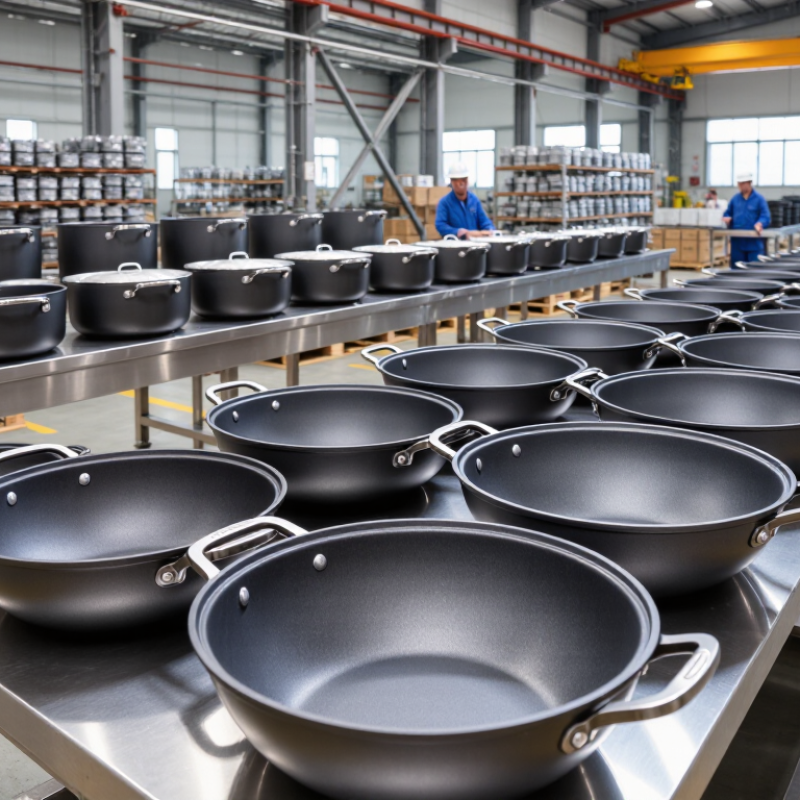
Hard-anodized kadhai production in China starts with aluminum sheet or a formed vessel. Manufacturers stamp or spin the metal into a deep, rounded shape, then trim the rim and smooth the base. The surface is cleaned before anodizing. In an electrical bath, controlled current builds a hard aluminum-oxide layer from the metal itself. It is not simply a coating painted on top. Process control matters. Uneven cleaning or inconsistent current can leave dull patches or areas with different surface hardness.

After anodizing, the vessel is rinsed and sealed to reduce porosity. Workers check wall thickness, rim alignment, base flatness, and the finish under clear lighting. Some factories also test coating thickness and resistance to abrasion, along with food-contact suitability for the intended market. Details matter. A kadhai should sit steadily on a cooktop, and its curved sides should be smooth enough for stirring and cleaning. Quality can vary between production runs, so buyers should request recent inspection records and samples from the same process. Even then, a sample cannot reveal every weakness. That is an imperfect part of sourcing, and worth acknowledging.

China Best Hard Anodized Cooking Kadhai Manufacturers? - How Hard-Anodized Kadhai Manufacturing Works in China

Manufacturing Stage What Happens Key Process Controls Typical Quality Checks Why It Matters
Aluminum material selection Aluminum sheet or formed aluminum components are selected according to the kadhai design and production requirements. Material grade, sheet thickness, surface condition, and incoming documentation are checked against the product specification. Incoming visual inspection, thickness measurement, and material-document review. A consistent starting material supports reliable forming and helps produce a vessel with even walls and a stable base.
Blanking and forming Sheet aluminum is cut into blanks and shaped into the bowl-like kadhai body using forming operations such as drawing or spinning. Tooling condition, forming sequence, lubrication, and part dimensions are monitored to limit wrinkles, cracking, and uneven thickness. Checks for shape, rim dimensions, base flatness, visible defects, and wall-thickness consistency. The vessel is generally formed before anodizing so the protective oxide layer can be applied to the finished aluminum shape.
Trimming and surface preparation Excess material is trimmed, edges are finished, and the aluminum is cleaned before the electrochemical treatment. Deburring, degreasing, rinsing, and surface handling are controlled to reduce contamination and inconsistent treatment. Visual checks for burrs, residues, stains, and surface damage. Clean, properly prepared aluminum helps the anodic layer form more uniformly.
Hard anodizing The aluminum body is connected as an anode in an electrolytic process, forming an aluminum-oxide layer on its surface. Bath condition, electrical settings, treatment time, part loading, and temperature are managed according to the process specification. Coating appearance and thickness are checked using methods appropriate to the part and specification. Hard anodizing creates an integral oxide coating; it is not a paint layer or a separate metal plating.
Rinsing and sealing After anodizing, parts are rinsed. A sealing treatment may be applied when required by the product design or process specification. Rinse quality, carryover between process stages, and sealing conditions are controlled. Inspection for staining or handling damage, plus process-record review and any specified coating tests. Sealing can help close pores in the anodic coating and improve corrosion resistance; the treatment used depends on the specification.
Optional cooking-surface finish Some product designs add a separate nonstick coating or other finish over or alongside the anodized surface. Any additional coating has its own surface-preparation, application, curing, and food-contact compliance requirements. Checks may include coating coverage, appearance, adhesion, and applicable market-specific compliance documentation. A nonstick coating is a separate feature and should not be confused with the hard-anodized aluminum-oxide layer.
Handle and component assembly Handles, knobs, or other specified components are attached using the design’s fastening method. Fastener type, assembly position, torque or setting where specified, and component fit are controlled. Checks for secure attachment, alignment, sharp edges, and movement under the defined inspection method. Sound assembly supports safe handling and helps the finished kadhai meet its intended use requirements.
Final inspection and testing Finished units are inspected and tested against the product specification and the requirements of the intended sales market. Sampling plans, test methods, acceptance limits, and traceability records are defined by the manufacturer or customer specification. Depending on the specification: dimensions, coating thickness, appearance, base stability, assembly, packaging, and applicable food-contact documentation. Test requirements vary by design and destination market; results should be assessed against the applicable specification rather than assumed to be universal.
Packaging and shipment Accepted products are protected against scratches, impact, and moisture during storage and transport. Packaging materials, product separation, labeling, carton strength, and packing instructions are checked. Packaging inspection, quantity verification, and review of required product or shipment documents. Appropriate packaging helps preserve the finished surface and reduces transit damage.

Note: Process details, coating specifications, and verification methods vary by product design, production line, and destination-market requirements. This table describes general manufacturing practices and does not rank individual manufacturers.

Key Quality and Safety Standards for Kadhai Manufacturers

China Best Hard Anodized Cooking Kadhai Manufacturers?

Key Quality and Safety Standards for Kadhai Manufacturers

Reliable kadhai manufacturers control the whole process, not only the final appearance. They should document aluminum alloy composition, batch numbers, forming temperature, and anodizing conditions. ASTM B244 offers a recognized method for measuring anodic coating thickness with eddy-current instruments. Thickness alone is insufficient. Coating adhesion, abrasion resistance, corrosion behavior, and thermal cycling also require verification. A bright surface can still hide weak processing.

Food-contact safety needs equal attention. EFSA’s 2008 scientific opinion established a tolerable weekly intake for aluminum of 1 mg per kilogram of body weight. Manufacturers should therefore test finished kadhais with acidic and salty food simulants, especially after repeated washing. EU Regulation 1935/2004 and Regulation 2023/2006 provide useful benchmarks for food-contact safety and production controls. For other markets, applicable national requirements should be checked separately.

Small details matter. Handles must resist loosening after repeated heating and cooling. The base should remain stable on a flat cooktop. ISO 2859-1 can support consistent sampling plans, but buyers should define acceptance limits before production. A certificate is not proof of every shipment. In practical factory audits, traceability records often reveal more than polished samples. The weak point is usually documentation. One missing retest should trigger investigation, even when the kadhai looks perfect.

How to Assess Chinese Hard-Anodized Kadhai Manufacturers

Assessing Chinese hard-anodized kadhai manufacturers begins with evidence, not polished catalog photos. Ask for anodizing specifications, alloy grade, coating thickness, hardness results, and batch records. A reliable factory should explain its process clearly. Request samples from different production runs. Small details matter. Check the rim, rivets, lid fit, and interior finish under bright light. In practical inspections, uneven coating can appear near handles or deep corners.

Factory capability is more than equipment. Review production flow, cleaning controls, sealing methods, and inspection checkpoints. Ask whether tests cover abrasion, corrosion resistance, heat cycling, and food-contact safety. Request current certificates and test reports from recognized independent laboratories. Documents should match the actual factory and product, not a trading office. Visit by video if travel is difficult. Watch how workers measure coating thickness and handle finished surfaces.

Commercial reliability also deserves close attention. Compare minimum order quantities, tooling charges, lead times, packaging strength, and replacement policies. A manufacturer that answers only with vague promises creates avoidable risk. Still, no supplier is perfect. One factory may offer excellent coating control but weak export packaging. Another may communicate well yet lack stable batch consistency. Use a written scorecard, retain sample records, and approve a pilot order before scaling. That extra step may feel slow. It can prevent expensive surprises.

Factors to Consider When Choosing a Manufacturer

China Best Hard Anodized Cooking Kadhai Manufacturers?

Factors to Consider When Choosing a Manufacturer

Choosing reliable hard anodized cooking kadhai manufacturers requires more than comparing online prices. Examine their production experience, material sourcing, and quality control records. A dependable factory should clearly explain its aluminum grade and anodizing process. Ask how coating thickness is measured and how often inspections occur. Vague answers deserve caution.

Request samples before placing a large order. Check the kadhai’s weight, balance, handle connection, and inner surface. The coating should look even, without dark patches, pinholes, or rough edges. Test the lid fit if included. Small details matter. I once focused too heavily on appearance and overlooked handle comfort during repeated cooking. That was a useful mistake.

Factory verification also matters. Review production photographs, audit reports, and available food-contact compliance documents. Confirm whether inspections cover heat resistance, coating adhesion, dimensional accuracy, and packaging strength. A professional manufacturer should provide traceable batch information and respond clearly to technical questions. Communication can reveal practical reliability. If specifications change without written approval, future orders may become inconsistent.

Consider production capacity, minimum order quantities, delivery schedules, and replacement procedures. Ask how damaged goods are documented and handled. A low quotation may hide thinner material, weaker packaging, or limited after-sales support. I would also compare two or three samples under the same cooking conditions. Real use often exposes weaknesses that a catalog cannot show.

FAQS

What is a hard-anodized cooking kadhai?

It is an aluminum pan treated through electrochemical oxidation. This process creates a darker, harder, more scratch-resistant surface. It is not painted aluminum. Heat moves quickly through the pan.

Why is heat response important in a kadhai?

Fast heat response helps fry spices and sauté onions evenly. It also supports steady sauce reduction. A broad base should heat consistently. Small burnt circles are a warning sign.

Does hard anodizing guarantee excellent cookware?

No. The label alone proves very little. Wall thickness, base design, handle strength, and production accuracy also matter. Inspection records and cooking tests provide stronger evidence.

How can buyers inspect a sample kadhai?

Check the rim, rivets, lid fit, and inner finish under bright light. Look closely near handles and deep corners. Uneven coating may appear there. Use a sample from an actual production batch.

Which manufacturing documents should buyers request?

Request alloy details, anodizing specifications, coating thickness, and hardness results. Also ask for batch records and food-contact test reports. Documents should match the actual factory and product. A trading office alone is not enough.

What factory processes deserve attention?

Review cleaning controls, sealing methods, and inspection checkpoints. Ask about abrasion, corrosion, and heat-cycle testing. Watch how workers measure coating thickness. Video visits can reveal practical details.

Can metal utensils damage a hard-anodized surface?

Metal utensils may leave marks over time. Some marks are normal. Deep scratches deserve attention. The surface is durable, not invincible.

What commercial factors should buyers compare?

Compare order quantities, tooling charges, lead times, packaging strength, and replacement policies. Weak packaging can damage good cookware during transport. Approve a pilot order before expanding. That extra step feels slow. It may prevent costly surprises.

Conclusion

A Hard Anodized Cooking Kadhai is a durable cookware vessel made from aluminum that has undergone an electrochemical treatment to create a harder, more protective surface. This process improves resistance to scratches, corrosion, and daily wear while supporting even heat distribution and efficient cooking. In China, manufacturing typically includes aluminum forming, surface cleaning, anodizing, sealing, quality inspection, and the installation of heat-resistant handles or accessories. Reliable production requires careful control of material thickness, coating consistency, dimensional accuracy, and finishing quality.

When assessing Chinese manufacturers, buyers should review their production capabilities, quality management systems, safety testing, export experience, and ability to provide consistent batch performance. Important selection factors include product design, customization options, minimum order quantities, lead times, packaging, communication, and after-sales support. Manufacturers that maintain clear inspection procedures and comply with applicable food-contact and product safety requirements are better positioned to deliver dependable cookware for different markets.

Ethan

Ethan

Ethan is a highly experienced marketing professional dedicated to helping customers understand the value, quality, and practical applications of our company’s products. With a strong background in market research, content strategy, and product communication, he combines industry insight with a......