
0%

Choosing the right China Best Scratch Resistant Non-Stick Pan Supplier requires more than comparing prices and polished product photos. A dependable supplier should explain its aluminum grade, coating system, curing temperature, base thickness, and quality-control process. These details affect daily cooking performance, especially when eggs slide across the surface or a metal edge touches the rim by mistake.

Michael R. Dugan, a cookware materials consultant with experience in coating evaluation, says, “Scratch resistance begins with surface preparation, not with advertising claims.” His point matters. A strong Scratch-Resistant Non-Stick Pan depends on proper pretreatment, even coating thickness, secure bonding, and controlled curing. Suppliers should provide abrasion-test results, food-contact compliance documents, batch records, and inspection photos. Ask for samples. Test them with wooden, silicone, and approved utensils under realistic kitchen conditions.

The best factory should also demonstrate stable production capacity. Look for traceable raw materials, clear defect standards, and responsive technical support. A pan that performs well once may not perform consistently across 10,000 units. That is where supplier experience becomes visible.

No pan is truly scratch-proof. That phrase deserves caution. I may be overly careful, but vague durability promises often hide weak testing methods. A responsible supplier will admit coating limits and recommend suitable utensils. This introduction examines China’s leading options through material quality, manufacturing experience, certification evidence, customization ability, and long-term reliability. The goal is practical selection, not exaggerated perfection.
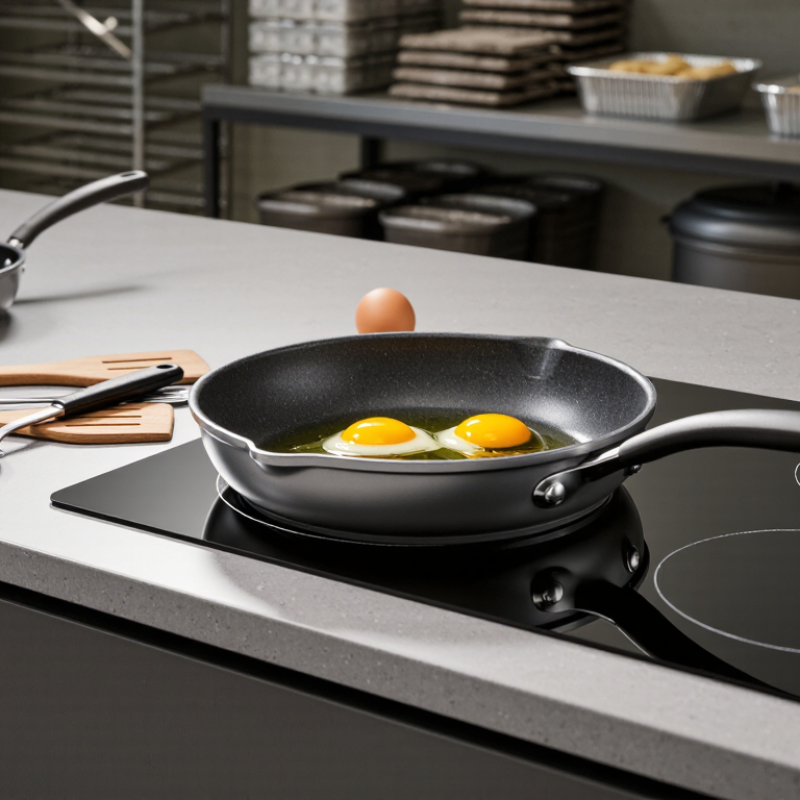
China Best Scratch Resistant Non Stick Pan Supplier?

What Defines Scratch Resistance? Coating Hardness and 15–40 μm Film Thickness

What Defines Scratch Resistance? Coating Hardness and 15–40 μm Film Thickness

Scratch resistance depends on more than a pan’s advertised coating type. Coating hardness measures how well the surface resists marks from utensils, cleaning tools, and repeated contact. Film thickness also matters. A 15–40 μm coating can provide a useful balance between protection, heat response, and surface consistency. However, thicker is not always better. Poor adhesion or uneven application can cause early wear.

During supplier evaluation, request coating thickness records from several points on the pan. Thickness should remain consistent around the cooking surface and sidewalls. Ask how hardness is tested, which tools are used, and whether testing reflects daily kitchen use. A laboratory result may look impressive, yet it cannot fully represent metal spatulas, gritty residue, or careless stacking. That assumption is too simple.

Tips: Check sample pans under strong light. Look for thin edges, bubbles, pinholes, or dull patches. Use approved utensils during trials, and repeat the test after washing. Keep written inspection results. Small details matter.

Reliable suppliers should explain their coating process clearly, including surface preparation, curing temperature, and inspection frequency. Practical testing should include heating, cleaning, and repeated utensil contact. Some suppliers may only provide one perfect sample. That is not enough evidence. Request multiple production samples and compare them after use. Scratch resistance is a measured performance feature, not a permanent promise.

Which Materials Perform Best? Aluminum, Stainless Steel, and 2.5–3.0 mm Bases

China Best Scratch Resistant Non Stick Pan Supplier?
Material choice matters more than glossy claims. Aluminum conducts heat at roughly 205 W/m·K, while austenitic stainless steel conducts near 16 W/m·K, according to ASM Handbook, Volume 2. Aluminum heats quickly under a thin non-stick coating. Stainless steel resists dents, deformation, and repeated handling better.

A 2.5–3.0 mm base offers a practical balance for daily cookware. It spreads heat more evenly across the cooking surface and reduces hot spots near the burner. The International Aluminium Institute lists aluminum’s density at about 2.7 g/cm³, compared with nearly 8.0 g/cm³ for stainless steel. That difference explains why aluminum pans feel lighter, while stainless-clad designs feel more solid. Still, thicker does not automatically mean better. Poor bonding can create uneven heating or slight base distortion.

Scratch resistance depends on the coating, curing process, surface hardness, and user habits. Technical guidance from ASTM coating-related testing standards supports controlled abrasion evaluation, but household performance can differ. A metal utensil may leave marks quickly. Even careful factories can miss edge defects. That deserves inspection. Suppliers should measure base flatness, coating adhesion, and repeated abrasion performance before shipment. In practice, an aluminum body with a 2.5–3.0 mm bonded base often delivers the best heat response, while stainless steel adds structural confidence. No material wins every test.

How Do Suppliers Prove Durability? Abrasion Tests, 260°C Heat Limits, and QC Data

China Best Scratch Resistant Non Stick Pan Supplier?

A reliable supplier should show more than polished product photos. Ask for an abrasion report using ASTM D4060 or an equivalent cookware-specific method. The report should identify wheel type, load, cycle count, coating thickness, and mass loss. These details matter because “scratch resistant” has no single universal pass mark. Some factories claim 10,000 cycles, yet provide no control sample or failure definition. That is a warning sign.

Heat performance also needs measurable evidence. Many PTFE-based coatings list about 260°C as a continuous-use limit, while empty pans can exceed this temperature quickly. Suppliers should perform thermal cycling near 260°C, then retest release performance, adhesion, and surface appearance. Food-contact documentation should follow applicable FDA or EU requirements. ASTM D3359 adhesion checks can support the record, although adhesion is not the same as cooking durability.

Real QC data reveals factory experience. Request batch records showing coating thickness, oven temperature, curing time, surface roughness, and rejection rates. A practical supplier may report results from at least three production batches, not one perfect sample. Look for variation.

Data can be imperfect. Test kitchens use metal tools, uneven heating, and repeated washing, unlike laboratories. Therefore, compare laboratory results with field-use trials. A supplier that explains limitations openly is often more trustworthy than one promising a “lifetime” surface.

What Certifications Matter? LFGB, FDA, PFOA-Free Claims, and ISO 9001 Systems

For a China-based scratch-resistant non-stick pan supplier, certifications need careful verification. LFGB refers to Germany’s Food and Feed Code. It supports food-contact safety testing, but it is not a universal product certificate. Ask for the test scope, laboratory accreditation, coating samples, and migration results. A report covering only the handle does not prove pan-body safety.

FDA compliance also requires precision. The U.S. Food and Drug Administration generally evaluates food-contact substances under applicable regulations, such as 21 CFR requirements. It does not usually “certify” complete cookware. Request a written compliance statement linked to the exact coating and production process. The OECD’s 2021 PFAS report listed 4,730 PFAS substances. Therefore, PFOA-free is a narrow claim, not proof of PFAS-free performance. Check the detection limit and testing date.

ISO 9001 measures the supplier’s quality management system, not scratch resistance. The ISO Survey 2023 recorded more than 1.2 million ISO 9001 certificates worldwide, showing its broad use. However, the certificate cannot replace performance evidence. Request abrasion-cycle results, adhesion testing, coating thickness records, and batch traceability. I would also inspect a real production sample. Paperwork can look perfect. One weakness remains: scratch tests may not represent metal utensils, dishwasher cycles, or uneven heating. A stronger supplier explains those limits instead of hiding them.

How to Compare China Suppliers: MOQ, Lead Time, OEM Capacity, and Warranty Terms

China Best Scratch Resistant Non Stick Pan Supplier?

Supplier comparison should begin with measurable terms, not attractive samples. Grand View Research valued the global cookware market at about US$19.8 billion in 2023. That scale encourages many factories to claim OEM expertise. Ask for a written MOQ by model, coating, handle, and packaging. A 500-piece MOQ may apply only to stock bodies. Customized colors or engraved bases can require 2,000 pieces. Confirm whether tooling costs are refundable. In my sourcing experience, standard orders often need 30–45 days after approval. New molds may add two to four weeks. Delays happen.

Inspect the OEM process closely. Request a pre-production sample, coating specification, abrasion-test method, and food-contact documentation. “Scratch resistant” is incomplete without a test load and cycle count. UN Comtrade trade data consistently places China among the leading exporters of kitchen articles, but export volume does not prove factory control. Ask who performs final inspection. Ask for batch photos, dimensional records, and a replacement plan for warped pans. Small details matter. Warranty terms should define coating peeling, abnormal warping, loose handles, and acceptable claim evidence. A 12-month warranty sounds useful, yet exclusions can make it nearly meaningless. Require response times, replacement percentages, and freight responsibility in writing. I would also test ten random units, not one perfect sample. That costs more, but one sample can hide inconsistent coating thickness.

China Best Scratch Resistant Non Stick Pan Supplier? - How to Compare China Suppliers: MOQ, Lead Time, OEM Capacity, and Warranty Terms

Comparison Dimension Supplier Profile A
Small OEM Workshop
Supplier Profile B
Mid-Sized Manufacturer
Supplier Profile C
Large Integrated Factory
What Buyers Should Verify
Typical MOQ per SKU 300–500 pieces 500–1,000 pieces 1,000–3,000 pieces Whether MOQ changes for different diameters, colors, coatings, handles, or packaging.
Sample Lead Time 7–15 calendar days 10–20 calendar days 15–30 calendar days Confirm whether the sample is stock, modified, or fully customized, and whether tooling is included.
First Bulk-Order Lead Time 30–45 calendar days 35–55 calendar days 45–70 calendar days Ask for a production schedule covering raw materials, coating, printing, inspection, and packing.
Repeat-Order Lead Time 25–40 calendar days 30–45 calendar days 35–60 calendar days Check whether capacity is reserved for repeat orders during peak seasons.
Pan Body Options Aluminum; 2–3 common sizes Forged or die-cast aluminum; 3–6 sizes Stamped, forged, or die-cast aluminum; broad size range Verify base thickness, flatness tolerance, wall thickness, weight, and compatibility with the intended cooktop.
Non-Stick Coating Choices Standard PTFE coating; limited color selection Multi-layer PTFE; selected ceramic options Multiple coating systems and application specifications Request coating technical data, food-contact compliance documents, application thickness, and recommended utensils.
Scratch-Resistance Evidence Internal test report upon request Internal report and batch inspection records Formal laboratory reports plus production quality records Confirm the test method, load, cycle count, utensil material, pass/fail criteria, and whether results apply to the quoted coating.
OEM Logo and Packaging Logo printing; basic custom cartons Logo, color box, inserts, labels, and barcode support Full packaging development and multi-market labeling support Clarify artwork approval, packaging MOQ, testing responsibility, and tooling or plate charges.
Tooling Capability Existing molds; limited new tooling New molds and handle modifications In-house or controlled tooling development Confirm mold ownership, maintenance fees, revision policy, and estimated tool life.
Quality-Control Process Final inspection; limited process records Incoming, in-process, and final inspections Documented quality system with traceable batch records Request inspection standards for coating adhesion, flatness, handle strength, appearance, and packaging.
Pre-Shipment Inspection Usually buyer-arranged Factory inspection available Factory and third-party inspection supported Define sampling level, defect classification, inspection cost, and shipment-release conditions.
Warranty Term 6–12 months 12–18 months 12–24 months, contract dependent Ensure the warranty defines coating failure, loose handles, warped bases, misuse exclusions, and claim evidence.
Warranty Remedy Replacement parts or credit for confirmed defects Replacement goods, credit, or negotiated compensation Documented corrective action and replacement or credit process Confirm claim response time, evidence requirements, freight responsibility, and maximum liability.
Export Documentation Commercial invoice, packing list, and shipping documents Standard export documents plus compliance files upon request Broader documentation and destination-market support Verify food-contact declarations, material information, test reports, and country-specific labeling requirements.
Best Fit Small trial orders and simple customization Growing brands requiring balanced flexibility and capacity High-volume programs and complex OEM development Select based on verified performance, total landed cost, communication quality, and risk control—not price alone.

Note: The ranges above are indicative procurement benchmarks for China-made non-stick cookware. Actual MOQ, lead time, testing, warranty coverage, and customization terms should be confirmed in a written quotation and purchase agreement.

FAQS

Which pan material usually heats fastest?

Aluminum conducts heat far better than stainless steel, so it responds quickly on a burner. Stainless steel feels stronger but heats more slowly. Paperwork is not proof.

Is a 2.5–3.0 mm base a useful thickness?

Yes, it usually balances heat spreading, weight, and daily durability. It can reduce hot spots near the burner. However, thicker metal cannot fix poor bonding.

Does scratch resistance depend only on the coating?

No. It also depends on curing, surface hardness, coating thickness, and user habits. A metal utensil may mark the surface quickly. Even careful factories can miss edge defects.

What safety documents should a supplier provide?

Request food-contact test reports, migration results, coating details, and laboratory accreditation. Check that reports cover the pan body, not only the handle. The documents should match the exact production process.

Does a free-from claim prove complete chemical safety?

No. A narrow free-from claim covers only one substance. Ask for the detection limit, testing date, and wider material information. I would not rely on one sentence in a brochure.

Does a quality-management certificate prove scratch resistance?

No. It shows that production systems are managed, not that pans survive scratching. Request abrasion cycles, adhesion results, coating thickness records, and batch traceability.

What should buyers confirm about minimum order quantities?

Ask for the minimum quantity for each model, coating, handle, and package. A stock-body quantity may be 500 pieces. Custom colors or engraved bases may require 2,000 pieces.

How should buyers check production consistency?

Request a pre-production sample, batch photographs, dimensional records, and final-inspection details. Test ten random pans instead of one perfect sample. It costs more, but one sample can hide uneven coating.

What warranty terms deserve close attention?

The agreement should define peeling, warping, loose handles, evidence requirements, and response times. It should also state replacement percentages and freight responsibility. A twelve-month warranty can still be weak.

Conclusion

Choosing the right Scratch-Resistant Non-Stick Pan supplier in China requires more than comparing prices. True scratch resistance depends on coating hardness, consistent application, and a film thickness typically ranging from 15–40 μm. Material selection also matters: aluminum offers efficient heat distribution, stainless steel provides strength and durability, while a 2.5–3.0 mm base can improve stability and reduce warping during use.

Reliable suppliers should support their claims with abrasion testing, temperature evaluations up to around 260°C, and complete quality-control records. Buyers should also review certifications and documentation such as LFGB or FDA compliance, PFOA-free declarations, and ISO 9001-based production systems. Finally, compare suppliers by MOQ, lead time, OEM development capabilities, packaging support, and warranty terms. A transparent factory that provides test results, consistent samples, and clear after-sales commitments is more likely to deliver dependable cookware for long-term use.

Amelia

Amelia

Amelia is a professional marketing specialist with a strong understanding of the company’s products, services, and customer-focused solutions. With experience in market research, content strategy, and business communication, she transforms complex product information into clear, practical, and......