Choosing the China Best Triply Induction Base Saucepan requires more than comparing prices, polishing, or advertised thickness. A reliable pan must heat evenly, respond quickly, and remain stable on induction cooktops. Its construction usually combines stainless steel, an aluminum core, and a magnetic stainless-steel layer. That structure supports better heat distribution and practical durability.
Market data shows why this category deserves closer attention. Grand View Research valued the global cookware market at approximately USD 19.79 billion in 2023. Its report also forecasts continued growth through 2030, driven partly by premium cookware and induction-compatible products. IMARC Group similarly identifies stainless-steel cookware as a strong segment because consumers increasingly value durability, hygiene, and easier maintenance. These reports describe market direction, not proof of one supplier’s quality. That distinction matters.
Stanley Cheng, founder of Hestan and a respected cookware innovator, has described cookware design as “a balance of engineering, performance, and everyday usability.” This principle fits every serious Triply Induction Base Saucepan evaluation. Buyers should inspect base flatness, wall thickness, weld quality, handle attachment, lid fit, and induction response. A saucepan may look flawless in photographs, yet develop hot spots during simmering. Not every “triply” claim means identical performance. Product testing remains essential.
This guide examines Chinese manufacturers through manufacturing experience, material transparency, quality controls, customization capacity, and export reliability. It also considers small details, such as whether the handle stays comfortable beside a steaming pot. No ranking is perfect. Supplier records, factory audits, sample testing, and customer references still deserve careful review before a purchasing decision.
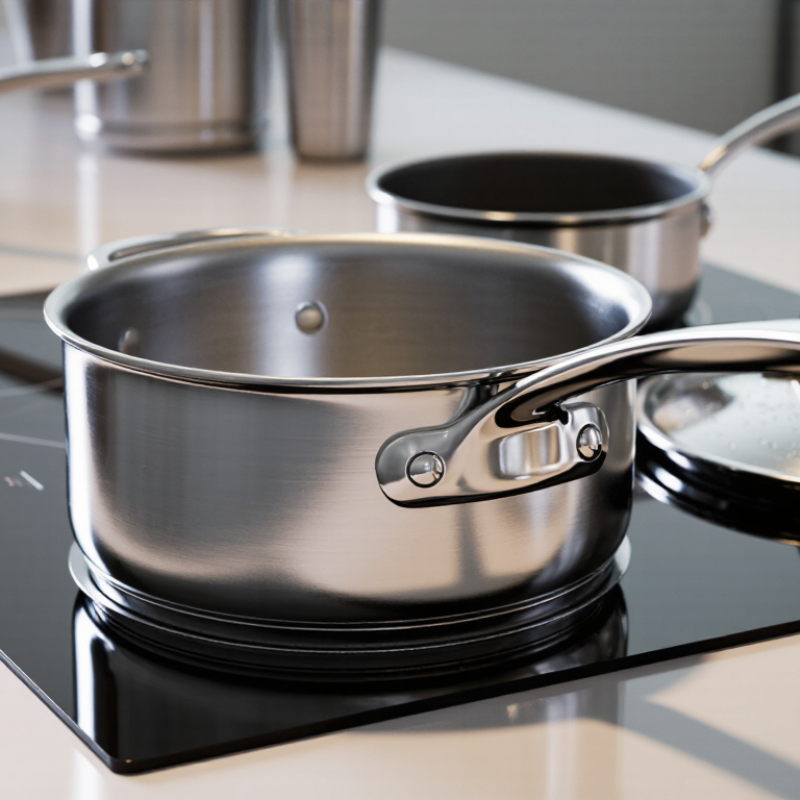
A triply induction base saucepan has three bonded metal layers beneath its cooking surface. Usually, stainless steel provides durability, aluminum spreads heat, and magnetic stainless steel connects with an induction hob. The base reacts to the magnetic field, while the aluminum core reduces hot spots around the center. This construction differs from full tri-ply cookware, where three layers continue up the sidewalls. The term is not perfectly standardized, so buyers should inspect the cross-section and technical specification.
Heat transfer matters in daily cooking. The U.S. Department of Energy reports that induction cooking transfers about 85% of its energy to cookware, compared with roughly 32% for gas cooking. Source: U.S. Department of Energy, Energy Saver, “Induction Cooking.” In practice, a 2-liter saucepan can heat soup quickly while its handle remains cooler than the body. That experience depends on base thickness, flatness, and hob compatibility. A manufacturer should provide magnetic-attraction tests, thermal distribution results, and corrosion testing. Simple claims are not enough.
A reliable China manufacturer should also control welding, polishing, and base bonding through documented inspections. Look for a flat bottom without visible separation or warping. Small flaws matter. Yet triply construction is not magic. Very thin aluminum may lose heat too quickly, while an overly thick base can respond slowly. I would compare boiling time, temperature variation, and repeated heating cycles before choosing a supplier. Even professional testing can miss uneven performance at low heat. Expect evidence, but keep questioning it.
A practical specification guide for evaluating triply induction base saucepans and manufacturing capability
| Evaluation Dimension | Typical Specification or Fact | Why It Matters | Recommended Verification |
|---|---|---|---|
| Product definition | A triply saucepan uses three bonded metal layers, commonly stainless steel on the cooking surface, an aluminum heat-spreading core, and stainless steel on the exterior. | Combines the corrosion resistance and food-contact suitability of stainless steel with the thermal conductivity of aluminum. | Review the cross-sectional construction, material certificates, and production samples. |
| Induction compatibility | The exterior base must contain a magnetic stainless-steel layer or a suitable induction-compatible disc. Aluminum alone is not ferromagnetic and will not work directly on most induction cookers. | Ensures the pan can receive energy from an induction cooktop. | Use a magnet test as a preliminary check, followed by a heating test on an induction hob. |
| Common material grades | Cooking surfaces are commonly made from 18/10 or 18/8 stainless steel. Induction-compatible exteriors may use magnetic stainless steel such as 430 grade. | The grade influences corrosion resistance, appearance, magnetic response, and durability. | Request heat or material analysis reports and confirm the specified grade for each layer. |
| Layer thickness | Commercial designs vary. A total body thickness around 2.0–3.0 mm is common for balanced weight, heating response, and durability; the exact layer ratio depends on the design. | Thickness affects heat distribution, pan weight, stability, and resistance to deformation. | Measure samples with suitable instruments and inspect the layered cross-section. |
| Heat distribution | The aluminum core spreads heat more quickly and evenly than stainless steel alone, although performance depends on core thickness, flatness, and bonding quality. | Reduces localized hot spots and supports more consistent simmering and cooking. | Perform a controlled heating test and compare temperature variation across the base. |
| Base flatness | A flat, stable base is essential. The base should remain stable during heating and should not visibly rock on a flat surface. | Improves contact with the induction surface and promotes consistent energy transfer. | Check the cold and heated pan on a calibrated flat plate or reference surface. |
| Size range | Common saucepan capacities include approximately 1.0–1.5 L for small portions, 1.8–2.5 L for general household use, and 3.0 L or more for larger servings. | Capacity determines cooking quantity, storage requirements, and the target consumer segment. | Confirm rim diameter, base diameter, usable capacity, and overflow allowance. |
| Handle construction | Common options include riveted or welded stainless-steel handles. Handle geometry should provide clearance from heat and a secure grip. | Affects safety, comfort, balance, cleanability, and long-term durability. | Inspect attachment points, conduct load testing, and check handle temperature during use. |
| Lid compatibility | A fitted stainless-steel or tempered-glass lid may be supplied, depending on the product configuration. The lid should seat securely and allow controlled steam release where required. | Improves energy efficiency, moisture retention, and handling safety. | Check lid fit, knob security, edge finishing, and steam-vent design. |
| Cooking-surface finish | Common finishes include polished, brushed, or satin stainless steel. The cooking surface should be smooth, clean, and free from pits, cracks, and sharp edges. | Supports hygiene, ease of cleaning, appearance, and user acceptance. | Use visual inspection, surface roughness checks where applicable, and cleaning-cycle tests. |
| Safety and compliance | Food-contact materials, coatings if present, welding, polishing, packaging, and labeling should comply with the regulations of the intended sales market. | Reduces regulatory, safety, and import risks. | Request applicable food-contact declarations, inspection reports, and traceability records. |
| Quality-control capability | A reliable manufacturer should control incoming materials, forming, bonding, base welding or pressing, polishing, assembly, final inspection, and packaging. | Consistent process control is more meaningful than appearance alone when comparing suppliers. | Audit process documents, inspection records, corrective-action procedures, and sample consistency. |
| Best-selection conclusion | The strongest option is not simply the lowest-cost supplier; it is the manufacturer that consistently delivers verified materials, stable induction performance, accurate dimensions, safe handles, durable bonding, and market-appropriate documentation. | Balances product performance, compliance, customer satisfaction, and long-term supply reliability. | Approve the supplier only after reviewing samples, test results, factory controls, and production consistency. |
The cooking surface should use food-grade 304 stainless steel. A pure aluminum core spreads heat quickly. The outer layer needs magnetic stainless steel for induction compatibility. Material certificates should confirm each layer.
Aluminum moves heat across the base quickly. It reduces hot spots during simmering. A thin core may heat unevenly. An overly thick core adds weight and cost.
Check layer bonding, base flatness, rim forming, and handle attachment. Look for gaps between layers. Check sharp edges and visible dents. Place the saucepan on a flat table. It should not wobble.
Test the saucepan on cookers with different power levels. Do not rely on one showroom unit. Heat a filled saucepan and observe simmering. The heat should remain reasonably even. Real testing can reveal disappointing results.
Buyers can specify diameter, wall thickness, handle shape, and lid fit. They can also request surface finishes and flatter induction bases. Packaging, labels, and carton sizes may be adjusted. Every detail should have written measurements.
No. Certificates support a quality system, but they do not prove daily consistency. Request material reports, laboratory testing, and batch records. Inspectors should check adhesion, leakage, deformation, and handle strength. A certificate cannot replace physical sampling.
Request three production samples instead of one polished sample. Measure every base with a straightedge. Test lid fit and handle balance. Wash the samples repeatedly. New cookware can hide weak finishing.
Compare the landed cost, not only the factory quotation. Include packaging, inspection, shipping, and possible replacements. Confirm minimum order quantities and shipping documents. Ask about corrective actions for defective batches. Cheap can become expensive.
A Triply Induction Base Saucepan is designed with three bonded layers that combine efficient heat distribution, responsive cooking performance, and durable food-contact surfaces. Its induction-compatible base must transfer energy evenly while minimizing hot spots, warping, and uneven cooking. When evaluating Chinese saucepan manufacturers, buyers should examine production experience, material traceability, equipment capabilities, engineering support, and consistency in large-volume orders rather than relying only on price.
Important considerations include the grade and thickness of stainless steel, the quality of the aluminum core, bonding strength, handle construction, surface finishing, and compatibility with different cooktops. Reliable suppliers should maintain documented quality-control procedures, conduct inspections throughout production, and provide appropriate certifications for the target market. Customization options may include dimensions, finishes, packaging, logos, and handle designs. The best supplier is one that can combine stable manufacturing capacity, transparent communication, dependable testing, flexible customization, and consistent delivery to meet the practical and regulatory requirements of each market.